Journal
Knitting from a 1944 Vogue Pattern: What I’m Making Next for My Maker’s Wardrobe
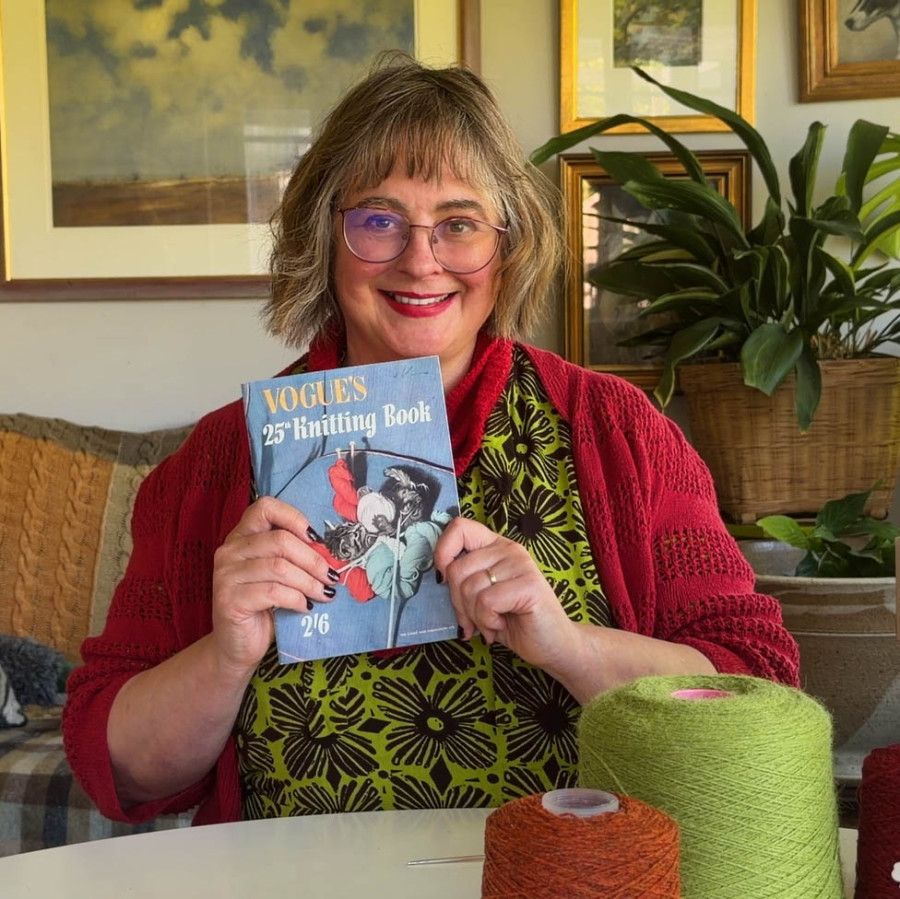
I’m on the sleeves of the current cardigan. Which means, predictably, my brain has completely moved on.
This is a pattern I recognise in myself. The nearer I get to finishing something, the louder the call of the next thing. The risk is always the same: abandon the current project, start something new, find the abandoned one five years later at the bottom of a bag. So this year, with the Maker’s Wardrobe project, I’m trying something different. I’m letting myself plan (swatches, yarn choices, thinking through the problems) but nothing gets cast on until the current cardigan is done.
In this week’s film I take you through the book I’m working from and the pattern I’ve chosen.
Vogue’s 25th Knitting Book, 1944
I collect vintage Vogue Knitting Books. Most of them (the 1950s and 60s issues) can be found for around £7. But the wartime books are a different matter. Fewer were printed. They were passed hand to hand, worn out, lost. Finding a genuine mid-1940s copy takes patience.
I spent some birthday money on this one. Twenty-three pounds for a single magazine, which felt extravagant until I opened it.
The book is edited under the direction of Audrey Withers, who ran British Vogue throughout the Second World War. Her stated purpose was to keep up the spirit and glamour of British women, to maintain the sense that beauty and fashion were worth protecting even in the middle of everything. The paper was rationed. Many of the photoshoots were taken on bomb sites. By 1944, wool was on coupon (with some exceptions for baby wool and yarn destined for the armed forces), and the knitting magazine reflects this at every turn.
What you get is not just patterns. You get instructions for unravelling old jumpers to reknit the wool. You get designs for knitted fronts (“dickies&rdquo that could be worn under a jacket to give the impression of a new blouse without requiring the coupons for one. You get colour-blocked designs that make a virtue of having two different partial balls of wool rather than enough of one. The whole thing is a lesson in making beauty within constraint.
The photographs are by Lee Miller, likely some of the last fashion photographs she took before she left for the front as a war correspondent. If you want to understand the world these patterns were made in, the film Lee (2023) is a good place to start. There’s also Dressed for War by Julie Summers, a biography of Audrey Withers, which is excellent.
A digitised copy of the book is held by the Glasgow Women’s Library: Glasgow Women’s Library
The Pattern I’ve Chosen
I’m making the wheat ear rib cardigan. It’s longer than the short cardigans I’ve been knitting. It sits below the waist and the rib stitch stands up in high relief. The neckline buttons high or opens out. There are pockets with a wheat ear edging.
The photograph is by Lee Miller. The model has red nails, a statement bracelet, and a jazzy scarf. It does not look frumpy. That matters, because I have had long cardigans before and something goes wrong and suddenly I am wearing a dressing gown and feeling blue.
I’m cautiously optimistic.
The practical challenges before I cast on are real. The pattern is written for a 34-inch bust, one size only, in a three-ply wool on size nine needles. I’m going to need to regrade it entirely, which means working out the maths from swatches before I start. In the film I talk through how I’m approaching this.
The Yarns
I’m choosing from three wools in my stash, all in autumn colours. The dresses this cardigan needs to go with are greens, bronzes, and dark burgundies. There’s a lambswool with a slight mottled quality, a lambswool-alpaca mix from John Arbon, and a cashmere. I’ll be swatching all three at different needle sizes, looking for the right drape rather than trying to hit the exact tension (since I’m regrading anyway).
Why This Project Matters
There’s something I keep coming back to with this book. These patterns were created under genuine hardship: paper shortages, rationing, bombing. The women making them, the women photographing them, the women knitting from them were living through something difficult. And the response was not to stop caring about beauty or craft. It was to find ways to keep doing it anyway.
I find that worth paying attention to.
The Maker’s Wardrobe project is about building a wardrobe of things I love and will actually wear, slowly, with attention, one considered piece at a time. Knitting from a 1944 pattern feels like the right extension of that.
You may also enjoy …
"Birch leaves in a bottle" embroidery part two
embroidered and appliqué picture of birch leaves in a bottle by Jane Lindsey of Snapdragon Life
3 years ago
A Maker’s Wardrobe: Where This Project Begins
A new project: building a wardrobe I actually want to wear, slowly and deliberately. Not minimal, not a reset. Just paying attention to myself for once.
7 months ago
Making an embroidered pincushion.
handmade pincushion from plant dyed velvet and freehand machine embroidery
3 years ago
Piecing Together a Crazy Quilt’s History, One Patch at a Time
Tracing an antique crazy quilt: how a hat lining and a silk handkerchief helped date it and find where it was made.
4 weeks ago
 RSS
RSS