Journal
Natural Dyeing with Sweet Cicely
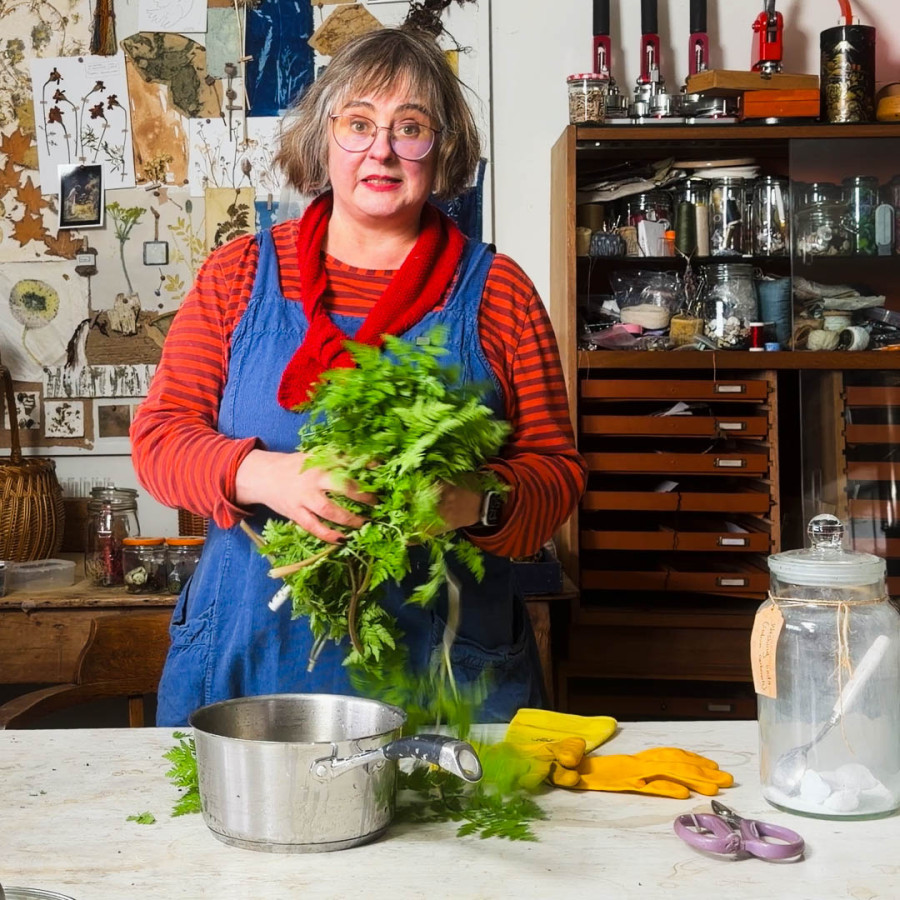
Sweet cicely (Myrrhis odorata) is one of my favourite dye plants, partly because it grows so well here in Scotland and partly because the whole studio smells of aniseed while you are working with it. It likes damp and shade and the shelter of hedges, and in this part of the country it does rather too well. I have a lot of it. Dyeing with it is one way of putting that to good use.
A bit of background
Sweet cicely is probably not a true native British plant. It most likely came over with the Romans, which would explain why it tends to be found near old settlements and buildings rather than in truly wild places. One of its old folk names is “the Roman plant.”
It has a long history of medicinal use. John Gerard wrote in 1597 that it was “very good for old people that are dull and without courage: it rejoiceth and comforteth the heart, and increases their lust and strength.” It was recommended for everything from babies’ colic to giving a general tonic to older women, and the roots and leaves were used as a blood purifier and wound ointment.
It was also used in cooking as a natural sweetener. The compound responsible for the aniseed scent, anethole, is sweeter than sugar, so sweet cicely was traditionally cooked with tart fruit like rhubarb and gooseberries to reduce the amount of sugar needed. During wartime rationing in the Second World War, people went back to foraging for it for exactly that reason.
Identifying it safely
If you are foraging for sweet cicely, please use a proper field guide with photographs and line drawings. Do not rely solely on an app.
The reason this matters is that sweet cicely belongs to the umbellifer family, the group of plants with umbrella-shaped flower heads. Some of its relatives can kill you. Hemlock is the obvious one. Sweet cicely itself is harmless, but you want to be certain.
The things to look for: the leaves are very soft and fern-like, not stiff or spiky. If you bruise them, they smell distinctly of aniseed. The leaves also have pale whitish markings near the base of the leaflets. Hemlock, by contrast, has a smooth stem often marked with red or purple blotching, and no aniseed smell.
Scent and colour
I have noticed that plants with strongly aromatic foliage tend to give good dye colour. Sweet cicely and fennel both smell of aniseed, and both give a bright, clean yellow. It is not a coincidence I think. The same compound, anethole, is responsible for both the scent and the dye potential.
Fennel may work better if you are somewhere warmer and drier than Scotland. If sweet cicely doesn’t grow near you, fennel is worth trying.
The method
This is a spring dye, which means speed matters. Early season leaves give the best colour, and you want to work quickly rather than simmering things for a long time. The fresher the leaves, the brighter the result.
What you need:
- As many sweet cicely leaves as will fit in your pan
- Washing soda (sodium carbonate)
- White wine vinegar
- pH strips or a pH meter
- Pre-mordanted wool or linen
- A stainless steel dye pan
Mordanting: The wool I used was pre-mordanted with aluminium potassium sulphate at 8%. If you want a video on how to mordant, leave a comment and I will make one.
Step one: make the dye bath
Strip the leaves from the stems and pack them into your pan. You want the pan fairly well filled but with enough space for the leaves to move around.
Add approximately one teaspoon of washing soda per large pan of water. The reason for this is that leafy dye baths tend to be slightly acidic, and the washing soda nudges the pH towards alkaline. What you are aiming for is something close to neutral. Add cold water to cover, put the lid on, and bring to just below a simmer. Keep it there for about 10 to 15 minutes. Do not boil hard and do not leave it for hours.
Step two: strain and adjust
Strain the leaves out into a large bowl or pan. Work fairly quickly at this point. Add cold water to bring the temperature down to hand hot.
Check the pH with a strip or meter. If the washing soda hasn’t been fully counteracted by the acidity of the leaves, the bath may still be on the alkaline side. You are looking for something close to neutral, around pH 7. If it reads higher, add a small amount of white vinegar, stir, and check again. Half a capful is usually enough. Do this somewhere well ventilated, as the reaction between the soda and vinegar fizzes and gives off fumes.
Step three: dye
Put your damp, pre-mordanted fibre into the dye bath while it is hand hot. If the bath were any hotter at this stage you could felt the wool, so check before the yarn goes in.
Leave for about an hour. The colour takes up quickly. You are looking for a bright yellow with a slight green quality to it, fairly fluorescent in good light. Linen takes up a similar yellow, slightly flatter than the wool but still good.
Rinse the yarn, hang to dry somewhere out of direct light, and leave for two to three weeks before washing. This settling period lets the dye pigments fully bond with the fibre. After that, wash in a pH neutral detergent.
What you end up with
A bright, slightly yellow-green. Not a dull yellow. This is one of the more satisfying spring dyes because the colour has a lot of life to it.
The linen came out well too. If you prefer to make sample books or dye cloth rather than yarn, sweet cicely works for that just as well.
You may also enjoy …
Getting started with overdyeing
using overdyeing in plant dyes natural dyes
5 years ago
Natural Dyes: Dyeing wool with Plum bark
how to dye wool with plum bark, natural dyeing, sustainable clothes
3 years ago
C17th knitted shirt inspiration; Studio Club Private Blog
2 years ago
Un-paper towels tutorial
making your own kitchen towel alternative tutorial
7 years ago
 RSS
RSS