Journal
Knitted Sports Knickers from 1914
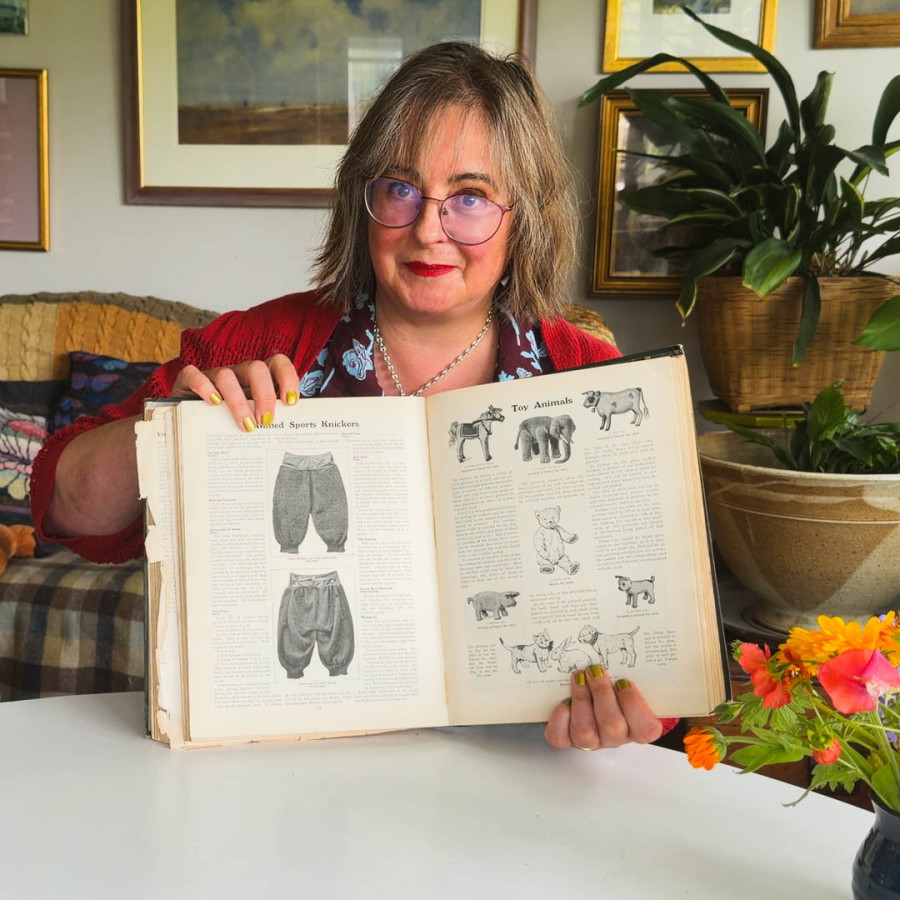
I acquired The Modern Knitting Book, edited by Flora Klickmann and published in 1915, as part of research for the current Studio season.
We’re currently making an almanac and looking at the period around 1900 to 1915, it is loosely centred on Edith Holden and her world.
The book opens with men’s wear, then women’s. First up for women: a cosy sleeping hood with elaborate lace frilling and ribbon, a garment for lying still and looking decorative. Much further in, after stockings and vests and wraps, the sports knickers. Dark wool, photographed flat. No woman wearing them. Just the garment, with a caption: these knickers are most comfortable for wear.
In 1914, “knickers” meant knickerbockers: a knee-length gathered garment, banded at the knee, worn for physical activity. Not underwear in the modern sense. The construction of this particular pattern though, with its back-buttoned flap and shaped sateen waistband, places it firmly as an undergarment worn during sport rather than as outerwear.
I went looking for other sports knickers patterns and one in an Australian newspaper, The Queenslander, from June 1914. When I looked at it though it was the same pattern, same wool specification, same notations, same photo. That pointed to a shared British source, which turned out to be Flora Klickmann’s other publication: The Girl’s Own Paper, a monthly magazine with a circulation of around 200,000, published by the Religious Tract Society.
I bought a bound annual from 1913/14 from an online bookseller for £10. And there on page 504 were the knitted sports knickers dated May 1914. Same photographs. This was the original.
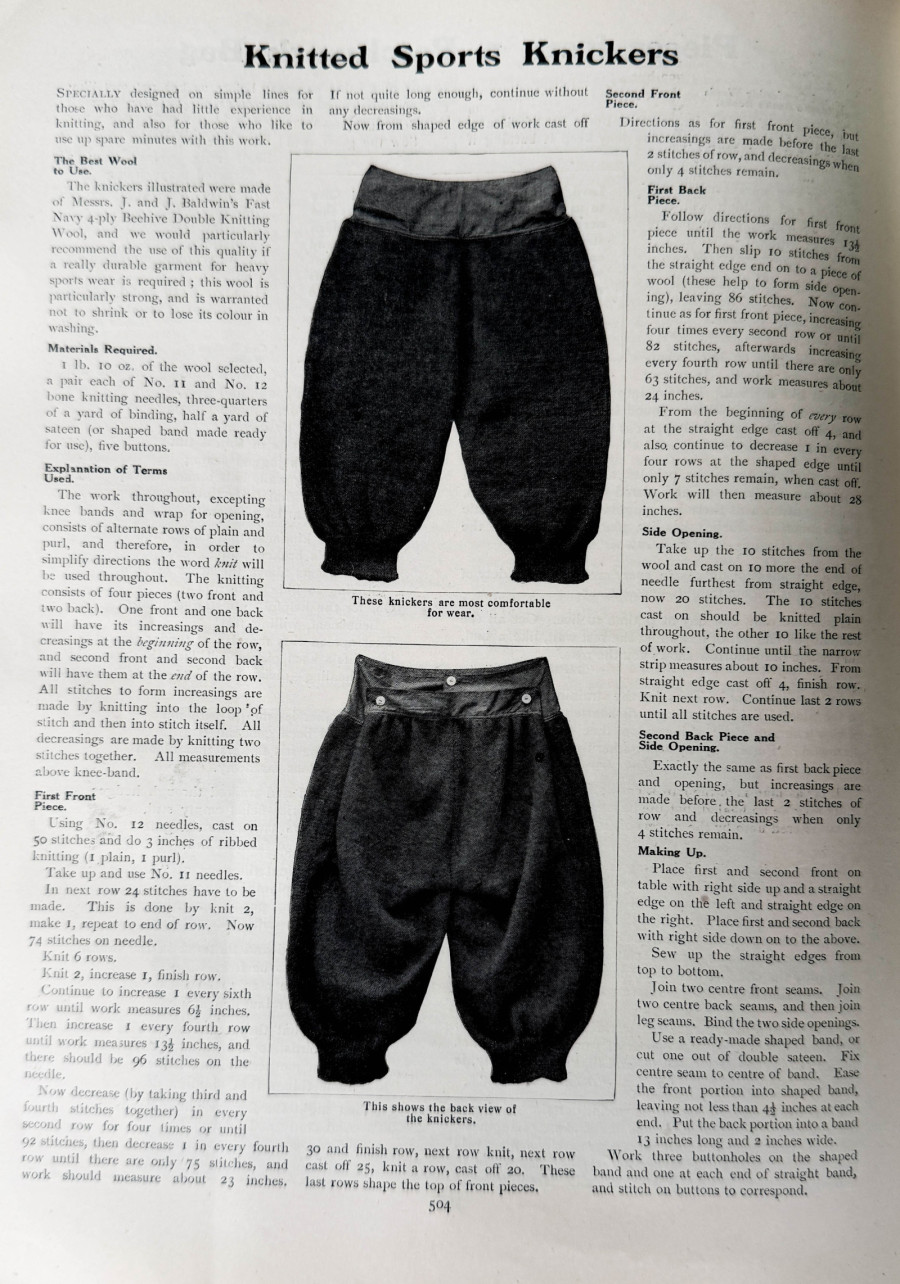
The Girl’s Own Paper in 1914 is a peculiar object. Published by a body whose founding purpose was moral instruction, it was also running articles on women’s finances, taxation anomalies for married women with incomes, careers in journalism, and what to do if someone proposes and you don’t want to accept. On the page facing the sports knickers: toy animals. The magazine hadn’t sorted itself into the categories we’d expect. It just contained what was there. I suspect that the overworked editor put in whatever she could easily get her hands on.
May 1914 is three months before Britain entered the First World War. The pattern predates the war entirely. The standard account says women became more physically active because of wartime factory work and the jobs left by enlisted men. But this shows that a conservative, religiously published magazine was already producing patterns for sturdy, dark, unshrinkable sports undergarments in peacetime. That’s not a magazine leading social change. It’s a magazine responding to what was already happening.
Masses of everyday women - Normal women as Philippa Gregory would say - were already playing very active sports. They just didn’t leave much of a visual record of doing it. This pattern is the record.
You may also enjoy …
Plantain and nettle balm
Plantago lanceolata history and use, ribwort plantain, balm recipe
6 years ago
Make a pretty honesty heart
making a heart decoration
6 years ago
Making daisy balm
How to make a soothing daisy balm for bruises
5 years ago
A J and J Baldwin’s Pattern Book
A 1920s Baldwin's pattern book with the knitted underwear women actually wore. Members can download the summer vest pattern itself.
1 month ago
 RSS
RSS