Journal
How to Dye Wool with Nettles
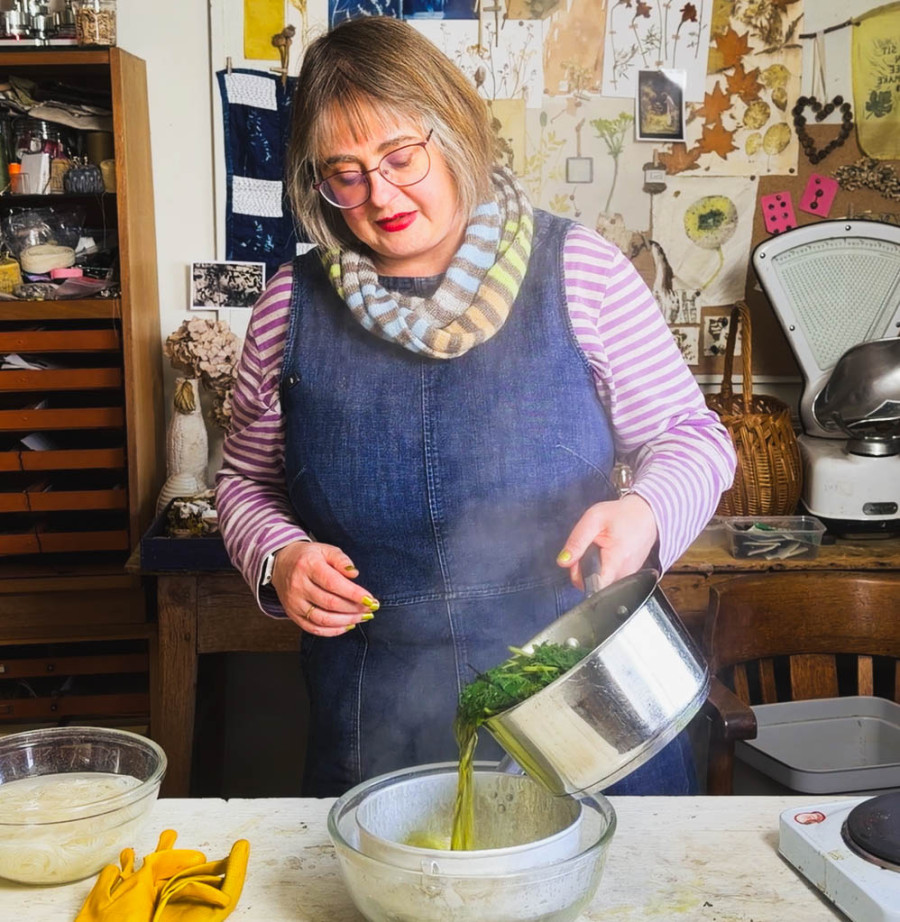
Nettles are one of the most useful plants in any dye garden, and one of the most underrated. They won’t give you a vivid, saturated colour. What they will give you is a soft, useful yellow-green that, with a quick iron modification, shifts into something really lovely: a pale pistachio, a grey-green, a colour that works quietly alongside everything else.
Here’s how I do it.
What you need
- Fresh nettles (I used 138g of leaves for 40g of wool, roughly 1:3 plant to fibre)
- Pre-mordanted wool (I used alum mordant - see the mordanting video in the playlist)
- A dedicated dye pan
- Washing soda
- pH indicator paper
- White vinegar
- Ferrous sulphate (iron) if you want to shift the colour
Gloves for picking the nettles. After that, once they’re in hot water, the sting is gone.
Step 1: Prepare the nettles
Pick your nettles and leave them on a path or flat surface for a few minutes. This gives any creatures a chance to get out before they go into the pan.
Add them to your dye pan. Don’t worry about packing them in perfectly.
Sprinkle over about half a teaspoon of washing soda. This is optional but useful: as the leaves boil, they tend to become acidic, and a small amount of alkali keeps things neutral. You don’t want an acidic bath for wool.
Pour over enough hot water to cover the leaves. I use a recently boiled kettle to speed things up.
Step 2: Simmer
Bring to a simmer, turn the heat to its lowest setting, put the lid on, and leave it for around 20–30 minutes. You’re looking for a bright, fluorescent green in the water. That’s your dye.
Don’t boil it for hours. The longer you go, the darker and duller the colour gets.
Step 3: Strain and check the pH
Strain out the nettles and compost them. Pour the dye liquor into a bowl.
Check the pH with indicator paper. You’re aiming for neutral; around 7. Because of the washing soda, it may read slightly alkaline (8 or above). If so, add a small splash of white vinegar, stir, and test again. Keep going in small amounts until you reach 7.
This matters. Wool goes into an alkaline solution and the fibre tightens up, the scales lift. It becomes harsh. You want neutral before your fibre goes in.
Let the bath cool until it’s hand-hot before you add your wool.
Step 4: Add the wool
Take your pre-soaked, pre-mordanted wool (it should have been sitting in plain water so it’s thoroughly wet through). Squeeze it firmly, submerge it in the dye bath, and let it go. Squeezing first pulls the water out and lets the dye in.
You’ll see colour taking immediately.
Leave it for a couple of hours. I don’t heat it further at this point, I just let it sit in the hand-hot water and work slowly. For nettles, I want to keep the colour as fresh as possible, so I don’t push it.
Step 5: Rinse (or modify with iron)
If you want a plain yellow-green: Lift the wool out, squeeze gently, and rinse in plain water until the water runs clear.
If you want pistachio green: This is where it gets interesting.
Make up a small iron bath in a separate container: about ¾ teaspoon of ferrous sulphate dissolved in cold water. Use different gloves for this; iron stains everything. Squeeze your wool out of the dye bath, submerge it in the iron bath, and watch it shift. You’ll see it moving towards green almost immediately.
Don’t leave it too long. You’re looking at wet colour, which will lighten as it dries. I usually take it out after a minute or two. A little iron goes a long way, and too much dulls the colour and weakens the fibre over time.
Rinse thoroughly after the iron modifier. More rinses than you think. Iron needs to come out completely.
The colours you’ll get
Plain nettles on alum-mordanted wool: a soft, pale yellow with a green tinge.
Nettles modified with iron: a pale pistachio, almost mint. The two colours together are really good; exactly the kind of neutral pairing that makes other colours in a project sing.
Both of these are useful colours. Not dramatic, not vivid. But quiet and versatile in a way that bright naturals often aren’t.
Here is a download of the instructions.
This is part of the Natural Dye Plants series. The mordanting wool video is also in that playlist.
You may also enjoy …
Harvesting dyer's chamomile from the dye garden
harvesting anthemis tinctoria, dyer's chamomile in the dye garden and planning new craft kits in natural dyeing
3 years ago
The Cult of the Needle by Flora Klickmann 1915
A flip-through of The Cult of the Needle, edited by Flora Klickmann in 1915.
2 months ago
Natural Dyeing with Buddleia: How to Get a Rich Gold from Garden Weeds
Buddleia gives a warm old-gold yellow on pre-mordanted wool and it costs nothing to collect. Here's the whole process, from spent flowers to finished skein.
5 months ago
Rosemary Napkin Rings
making rosemary napkin rings as sustainable Christmas table decorations
8 years ago
 RSS
RSS