Journal
A Maker’s Wardrobe: The Embroidered Waistcoat
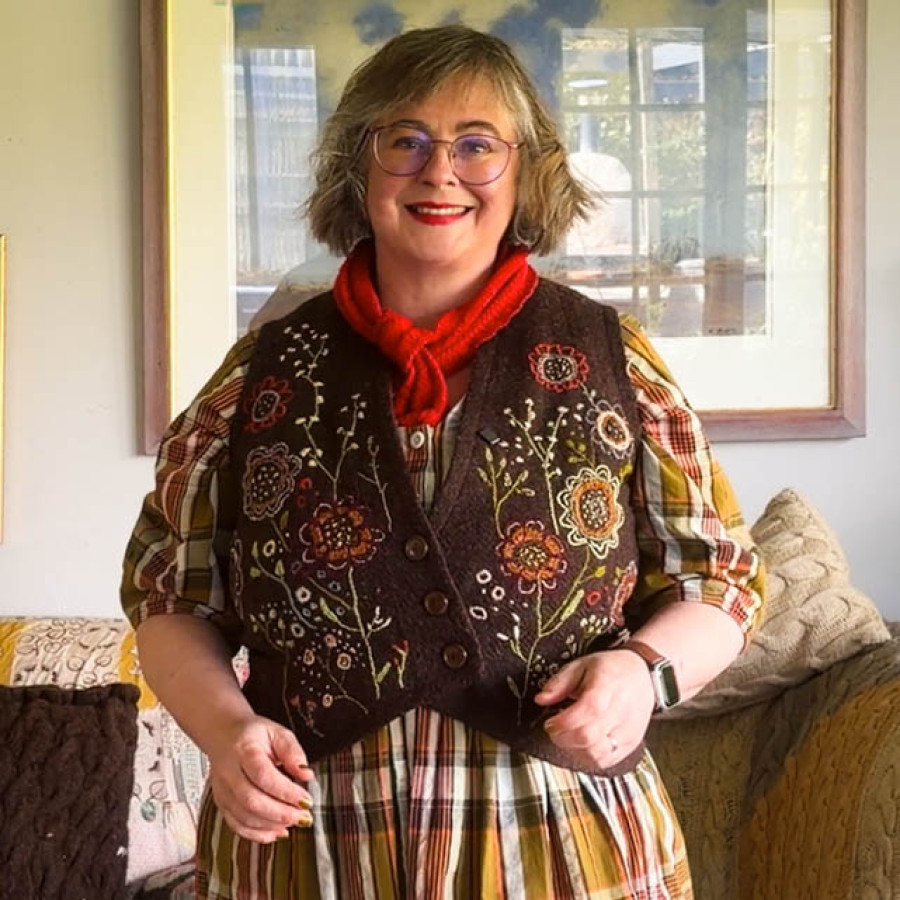
I bought this waistcoat when I was about 15 or 16, at a Phillips auction house in Edinburgh. It was the first of their fashion sales, built around a genuinely remarkable collection: Balenciagas, Chanels, the sort of thing that drew people in. Then around that core was everything else: the odd lots, the things that didn’t quite fit, the items that had come in when they announced the sale in the papers and people started clearing out attics.
I knew the people at Phillips well. My mum had opened an antique shop when I was about eight or nine, so I’d grown up in auction houses, going straight from school to help pack things into boxes, loading them onto George Street, knowing everyone by name. I think they were probably quite indulgent of a teenager with pocket money, because I managed to buy a number of those odd lots for less than a pound each.
This is why my collection of costume has some very peculiar things in it. Six Edwardian sleeves, none of them matching. That kind of thing.
The Waistcoat
The waistcoat came as part of a lot with a matching cape. It’s made of a very dark brown, open-weave Scottish tweed, bespoke-made in Mayfair, and beautifully constructed: unlined, with all the seams either finished immaculately or taped with silk ribbon, hemmed over by hand. Very simple lines. Asymmetric buttons at the front. Completely plain.
I bought it with some idea of turning into Katharine Hepburn. Very beautiful, very minimal. And then I never wore it. When I left home a few years later, it went into a case in my mum’s attic, where it stayed for decades.
When she started downsizing recently, it came back to me.
At 15, it was too big and boxy, giving me a very severe look. When I tried it on now, it was quite snug, and suddenly it’s a completely different shape. Simple still, but curved and fitted. I have genuinely grown into this waistcoat, which is a satisfying thing.
But it was still too plain for me. I kept trying it on with things and taking it off again. Something about it felt too heavy, too empty. Then I realised I’d been pinning a lot of Romanian and Bulgarian embroidered waistcoats on Pinterest, those densely worked folk pieces with flowers covering every surface. I thought: what if I tried something like that?
The Embroidery
I packed the waistcoat and a bundle of threads for a trip to Naples. I started with a white pencil, drawing flowers directly onto the cloth. No pattern, no plan, just drawing each flower as I went.
I don’t like symmetry. There’s something about it that makes me uncomfortable. With the asymmetric buttons, a symmetrical layout wasn’t really possible anyway. So I started with a flower here, a roughly corresponding one on the other side in terms of scale, and then filled everything else in around them.
The wools are leftovers, mostly from kits, things I’d accumulated. I added in some threads I’d dyed myself from the garden, a wool-silk mix, which is why they have a slight sheen. The stitches are all very simple: stem stitch, chain stitch, something approximating satin stitch, French knots, running stitch. Nothing technical. Just built up, and up, and up.
It might not be finished yet. I might add beading. But it’s in a state now where I’m wearing it, and it goes surprisingly well with a lot of things: checks, stripes, even florals. The layering of a dress, waistcoat, cardigan or jacket, and a scarf is something I love very much.
The Thing About Handwork
While I was stitching, I became aware of how much time it was taking. It’s enjoyable work, but it is a lot of time, and for something as small as a waistcoat front, that made me stop and think.
The things I’m naturally drawn to wear are things with colour and pattern and texture: embroidery, fair isle, lace, hand knitting. All of those take time. And if you love that kind of clothing and want to buy it rather than make it, you need to think quite carefully about what you’re paying.
When you buy something in a shop, 20% comes straight off for VAT. Then rent, staff, electricity, rates, marketing, styling: all of that takes roughly another 45% of what’s left. Every time there’s a middleman in the supply chain, another 50% of the remainder disappears. By the time you get down to the person who actually made the item, they’re seeing somewhere around 5 to 8% of whatever you paid. That applies from couture down through the middle market and on to fast fashion.
If you want the person who made a handmade piece to be paid a living wage, in safe conditions, the price has to be quite high. That’s not anyone being greedy. It’s just how the numbers work.
The alternative is vintage, which can also be expensive, but for good reason. Or you make it yourself, and in doing so, you also start to shrink your ideas about how many things you actually need.
What It Means to Choose Handwork
There’s a particular problem with a cheap embroidered item. If a piece of clothing costs £35 and has hand embroidery on it, the person who did that embroidery is almost certainly not being paid fairly for their time. If it’s priced as a disposable fashion item, it’ll probably be treated as one: worn for a season and then gone. The embroidery, which someone sat and made stitch by stitch, ends up in landfill.
Spend £350 on the same piece, and the maker might be getting £18. Still not a great deal, but you’re likely to treat it differently. You’re likely to keep it, mend it if it needs mending, think about passing it on.
Spend the time making it yourself, and the calculation shifts again. You know how long it took. You’re not going to throw it away. You’ll mend it, you’ll adapt it, and there’s a reasonable chance it’ll outlast you.
Those of us who love heavily decorated, layered, handworked things have to reckon with this more than people who prefer a minimal aesthetic. The things we want take either real money or real time, and if we try to get them cheaply, someone else pays the cost we should have paid.
The waistcoat took a lot of hours. I am entirely delighted with it.
Somewhere in my mum’s boxes there is also a matching cape. I haven’t found it yet.
This film is part of A Maker’s Wardrobe, an occasional series about the clothes I’m making, altering, and embroidering.
You may also enjoy …
Wrapping with tiny dogwood hoops
ideas for sustainable foraged gift wrap and table decorations
4 years ago
A Maker’s Wardrobe: Where This Project Begins
A new project: building a wardrobe I actually want to wear, slowly and deliberately. Not minimal, not a reset. Just paying attention to myself for once.
6 months ago
Making a knitted coat hanger
make a striped knitted clothes hanger beginner knit
3 years ago
Dyeing with Hopi sunflower seeds (Tceqa’ Qu’ Si)
dyeing with hopi sunflower seeds, natural dye
4 years ago
 RSS
RSS