Journal
Rag Rugs, Remembered: Creativity, Memory, and the Quiet Legacy of Women’s Work
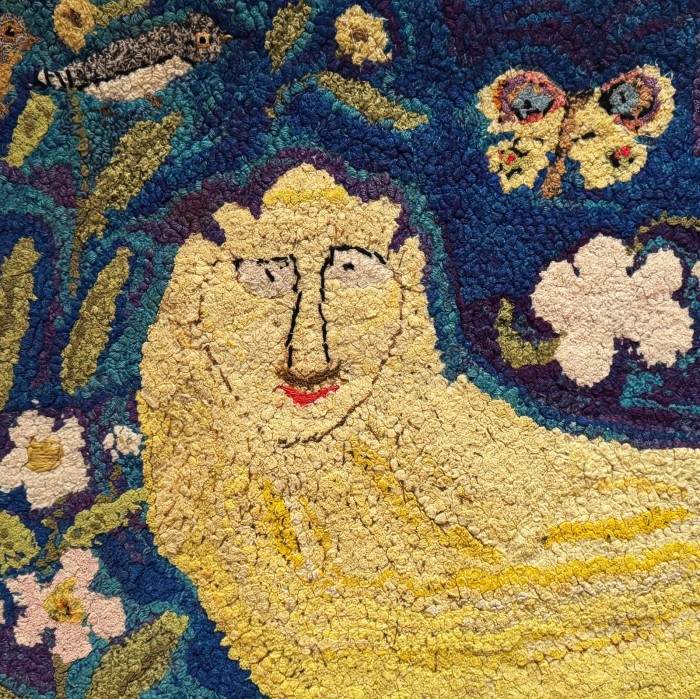
There’s something deeply evocative about a rag rug.
For me, they conjure childhood memories—of my gran cutting up old clothes in her Northeast home, of hands busy at the hearth as winter crept in. Every year, she’d make a new rug. Not as art, but as necessity. And yet, looking back, it was art. Quiet, domestic, fiercely resourceful art.
Rag rugs are humble. Scraps turned into something sturdy, beautiful, and useful. And lately, my fingers have been itching to make one. Partly due to the powerful exhibition I saw recently—Winifred Nicholson: Cumbrian Rag Rugs at the Tullie Museum in Carlisle—and partly because I’ve inherited my gran’s rug frame. A piece of family history, waiting to come alive again.
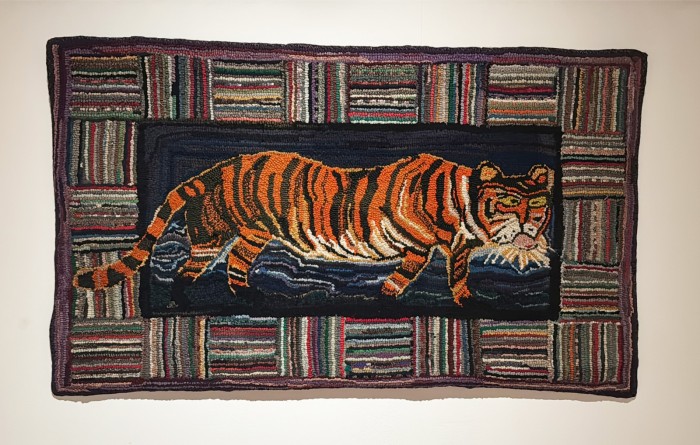
Tiger, worked by Janet Heap early 1960s
A Different Kind of Creativity
The exhibition explores how Winifred Nicholson—a respected artist—collaborated with rural Cumbrian women from the 1920s through the 1980s to create striking rugs. Though Nicholson provided loose design ideas, the true artistry lay in the hands of makers like Mary Buick. Her work, full of precision and pictorial nuance, told stories through stitches. Yet in art history, her name is often lost behind Nicholson’s.
This discrepancy matters.
It reflects how society has long undervalued women’s domestic creativity. Rug-making, quilting, embroidery—seen as craft, not art. Functional, not visionary. And yet, these works were acts of deep care, resourcefulness, and yes—creative genius.
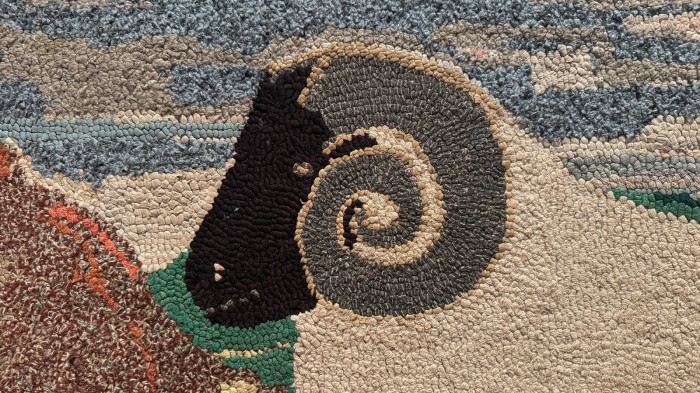
Sheep, worked by Mary Bewick to design by Winifred Nicholson 1960s
Making With What You Have
British rag rugs evolved from scarcity. No pre-planned palettes or bought-in fabrics—just old coats, worn sheets, a t-shirt you no longer needed. In the Northeast, these were called clippy mats or proggy rugs, and they followed simple geometric designs. My gran always used diamonds—drawn on old hessian sacks, filled in with whatever colours were on hand.
In contrast, American traditions turned rug making into a designed-from-scratch craft. But in the UK, it was about making do. And in that “making do,” women made beauty.
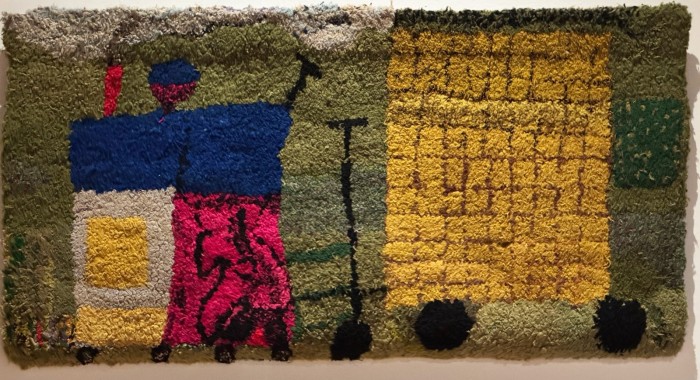
Tractor and Haycart, worked by Mrs Hall to design by Jovan Nicholson 1967
Creativity as Reclamation
Watching the exhibition’s rugs—some damaged, worn, obviously lived with—was unexpectedly moving. They hadn’t been preserved behind glass. They’d been stepped on, warmed toes, sat beside fires. They were loved, and used, and that’s part of their magic.
It reminded me that creativity doesn’t need polish. It needs space. Time. Willing hands.
And it reminded me that our making—however small or irregular—is a way of reclaiming ourselves. Especially for women whose time, historically and still, has so often been claimed by others.
What’s Next
I’ll be making my own rug soon. I don’t have long strips of wool, so it’ll be a clippy mat—shaggy, abstract, full of texture and colour. I’ll be working with what I have, like my gran did. Like so many did.
If you’ve made a rug, or remember someone who did, I’d love to hear. If you’ve been to the exhibition, let me know what stayed with you. Creativity is always richer when it’s shared.
You may also enjoy …
Why Victorian Needlepoint self destructs
A Victorian needlepoint bought for £8 is destroying itself. The culprit is the black dye. What this tells us about iron in natural dyeing and what to do with damaged heirloom textiles.
4 months ago
Inspiration: Neolithic Art in Argyll
Taking inspiration from neolithic rock art in Argyll, Scotland.
1 year ago
Dye Plants; Indigo: Studio Club Private Blog
2 years ago
Dyeing with Hopi sunflower seeds (Tceqa’ Qu’ Si)
dyeing with hopi sunflower seeds, natural dye
5 years ago
 RSS
RSS