Journal
Piecing Together a Crazy Quilt’s History, One Patch at a Time
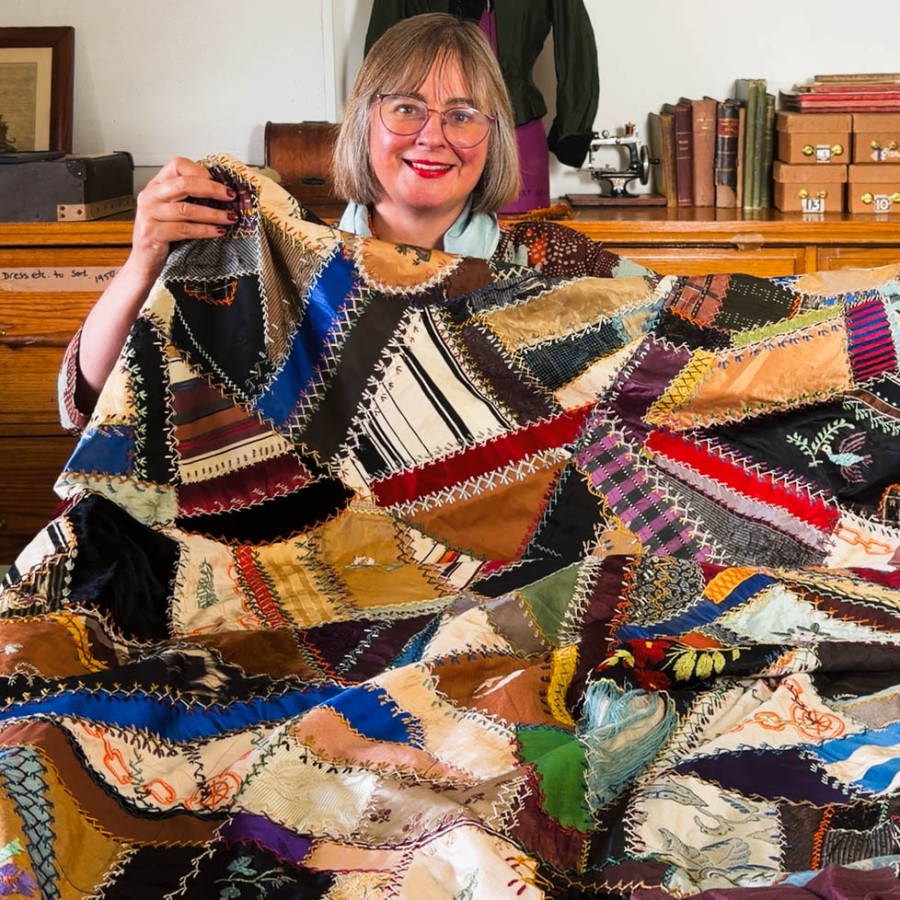
I bought this quilt last year from an American dealer on eBay. It was listed as an Amish quilt from the 1880s, he got it from an Amish estate sale. this is about what the quilt itself reveals once you actually look closely.
This is crazy patchwork, the theme running through The Studio this season, and I wanted to start by really looking at one piece to show what it’s actually made of.
Where Crazy Patchwork Came From
Crazy patchwork grew out of a 1870s craze for Japanese design, sparked by the Japanese pavilion at the Philadelphia World’s Fair. Western eyes saw pattern piled on pattern, asymmetry, colours that shouldn’t work but somehow did, interestingly this reaction is quite different from the calm minimalism we associate with Japanese design now.
The style was first called Japanese patchwork, then kaleidoscope patchwork, before crazy patchwork stuck. The “crazy” doesn’t mean mad. It comes from crazed ceramic glazes, another fashionable import of the time.
Nine Blocks, One Quilt
My quilt is made of nine blocks on a cotton backing, built up corner by corner with raw edges hidden under embroidery. What struck me most is how much ribbon is in it, about 60% of the patches by my count. Ribbon has finished edges already, so it made the piecing far quicker.
A Hat, a Handkerchief, and a Mystery Solved
A wheel-and-chain motif repeats across several patches, and its machined border suggests it came from a silk handkerchief. Then there was the patch that puzzled me for ages: silk printed with “John A. Richley, Elkhart, Ind.” It made no sense as quilt fabric until I found out hat linings were sometimes repurposed this way. A quick search turned up his shop in Elkhart, which places the quilt maker somewhere near there. The auction the Ebay seller mentioned was in Shipshewana, about 30 miles away, so it hasn’t travelled far, until now.
Beyond that, the motifs you’d expect: flowers, a dove with an olive branch, a moon and star, even an attempt at a Japanese fan. Some of the silk patches, have shredded with age. That’s the metallic mordants, not wear.
What’s Underneath
I unpicked a little hand-stitching at the edge to peek inside. The motifs were embroidered after the blocks were assembled, and the blocks themselves were joined with a simple running stitch, hidden under whichever decorative edge sat on top.
What We Don’t Know
We don’t know who made this quilt. We know she loved colour, had a good stock of ribbon off-cuts, an old handkerchief worth reusing, and access to a hat bought in Elkhart, Indiana.
Whether it’s genuinely Amish, I can’t say for certain. It goes against what I think of as an Amish quilt, but then so many things turn out to be more complicated than I first assume.
If you’re a Studio member, I’ll be looking at more crazy quilts from our collection over the coming weeks, starting with a few more block-based ones before moving on to the freeform style, which is pieced quite differently.
You may also enjoy …
Vogue’s 20th Knitting Book, page by page
A wartime Vogue knitting book, dated to 1942, and the page where Vogue explains its own coupon economy to readers.
1 month ago
Why We Buy Online Courses and Never Start Them (And Why That’s Perfectly Fine)
Why we buy online courses and never start them - plus how to release the creative guilt around unfinished learning. It's more normal than you think.
1 year ago
Making a Knitted Soap Saver
free patterns for making a soap saving mitt
7 years ago
Making a Bag from a UFO: 500 Years of Canvas Work
I turned a Victorian needlepoint chair cover into a bag and looked at 500 years of canvas work along the way. Why was Berlin wool work derided? The answer says a lot about class.
5 months ago
 RSS
RSS