Journal
Elsa Schiaparelli at the V&A: The 1930s Couture Collection
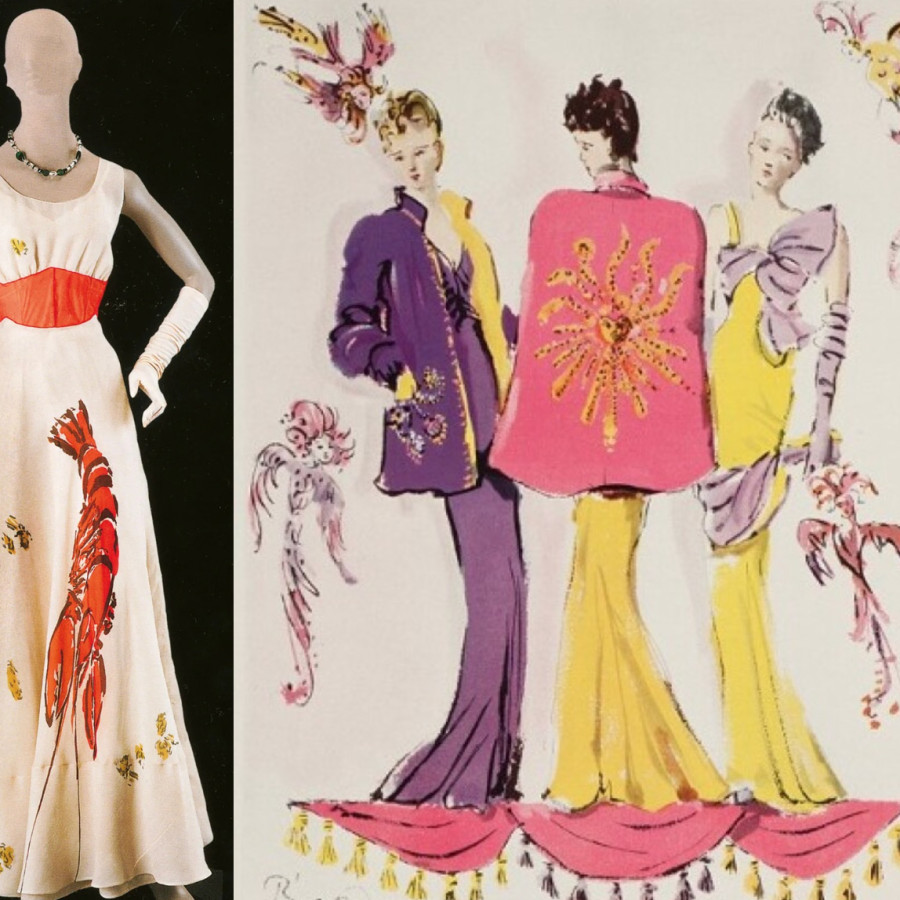
Part two of my tour of the Schiaparelli exhibition at the V&A, London. On until 8 November 2026.
In part one I looked at Schiaparelli’s early career and the knitwear designs that launched her. We left her in 1929 with a new investor, M. Khan, and ambitions to become a proper Parisian fashion house.
The timing was not ideal. October 1929 was the Wall Street Crash.
Surviving the Depression
Many fashion houses didn’t make it through the 1930s. Schiaparelli not only survived but grew, and there were four reasons for that.
She had strong contacts in America and Britain, and when people started buying domestically during the financial crisis, she responded by incorporating American and British products into her designs. She licensed her designs into American department stores, making them accessible at a lower price point to an upper-middle-class market. She began selling ready-made items from her own boutiques: scarves, swimwear, pyjamas, perfume, bags. And she concentrated the public-facing, media-facing part of her couture business on extreme luxury pieces that were impossible to ignore.
The last point is the interesting one. While most of the couture money came from well-made, quietly detailed suits and dresses, what got into the newspapers was something else entirely.
This is a tour of the exhibition.
And here is a Gallery of images
You may also enjoy …
A Maker’s Wardrobe: Swatching a WW2 Knitting Pattern
I'm knitting a cardigan from a 1944 Vogue pattern, and it's teaching me to knit differently. This is the swatching stage: four yarns, one stitch, and why I'm finally a convert.
3 months ago
The Cult of the Needle by Flora Klickmann 1915
A flip-through of The Cult of the Needle, edited by Flora Klickmann in 1915.
2 months ago
Making Simple Festive Table Decorations
tutorial to make simple seasonal Christmas table decorations
6 years ago
Bundle dyeing yarn: a November experiment
Yarn bundled with leaves, frost on the hedgerows, observing the small transformations of late autumn.
10 months ago
 RSS
RSS