Journal
A Maker’s Wardrobe: Swatching a WW2 Knitting Pattern
My mum’s craft room used to be full of my unfinished projects. Recently she got frustrated trying to clear it and started making things into cushions, bags, and pin cushions, giving them away to people. She handed one back to me at Christmas: a moth jumper from Susan Duckworth’s book, which I had clearly got halfway up the back and abandoned sometime in the 1980s. It is now a cushion. A rather nice one.
I don’t think of abandoned projects like that as failures. I think they’re often a symptom of curiosity. A project that got started because something was interesting, and then the interesting thing moved on. That’s fine. The problem comes when the abandoned things pile up and give the inner critic something to work with. The voices that say you never finish anything, you’ve got no staying power, look at all that wasted yarn. Those voices are very good at dimming creativity.
So over the last month I’ve been sorting through the studio. Frogging what can be frogged. Selling unfinished knits on Vinted (surprisingly brisk market for them). Binning the genuinely unsalvageable.
The cardigan that nearly wasn’t
But some of what came back to me wasn’t the hopeless-case category. It was the almost-finished category. Including a cardigan I made when I was sixteen, in colours not unlike the ones I still reach for now, which is essentially complete except for the front rib. That is all that was missing. It fits. It just doesn’t have the rib.
I am, apparently, a person who abandons projects at the final rib.
Also at the second sock past the heel turn. Also at the last twenty rows when my mind has already moved on to the next thing. The project goes into a bag in a cupboard and that’s that.
This is what I am trying to change with this project: not just to knit a cardigan, but to knit it differently than I have knitted before.
The pattern
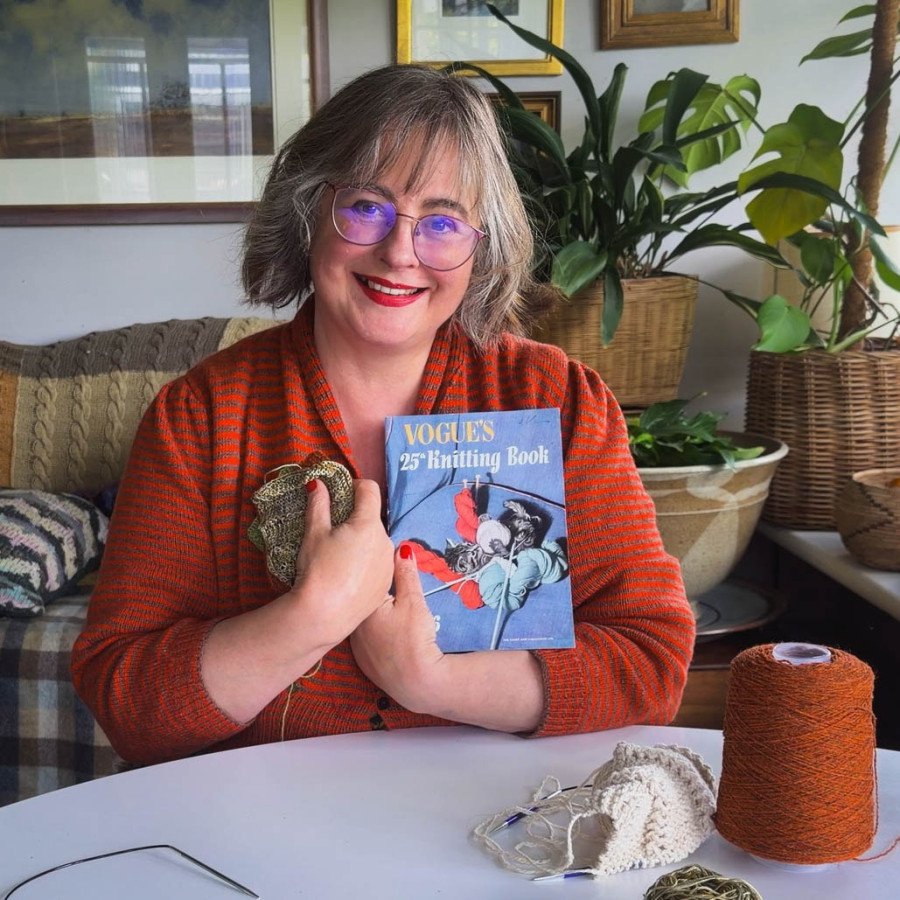
This is part of my ongoing Maker’s Wardrobe series, and the cardigan I’m making is from Vogue Knitting Book No. 25, a wartime pattern book. I have a whole separate film about this book if you want the full context, but briefly: it’s from the Second World War, it has photographs by Lee Miller, and it was produced under wartime rationing conditions when making what you had last was the whole point.
It’s a single-size pattern. Designed for a 34-inch bust, which is not mine, so I’ll be regrading it. That’s a whole thing for another film.
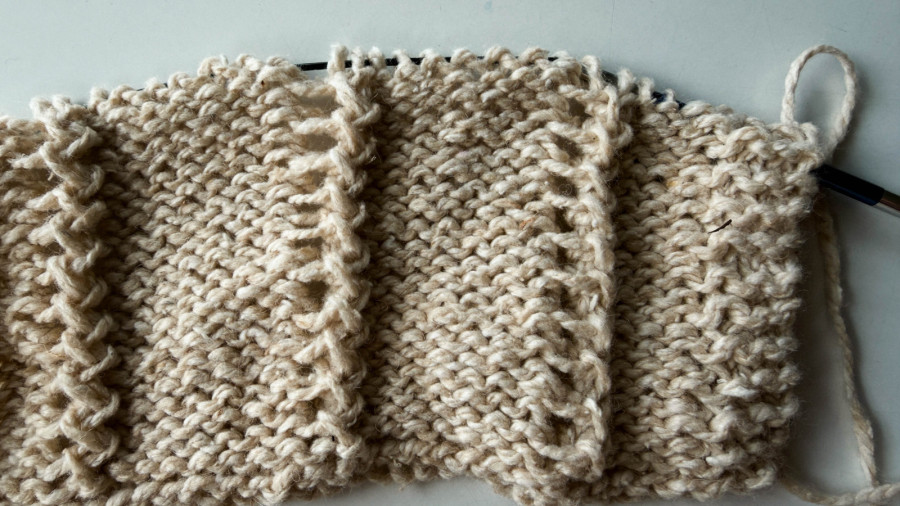
The stitch is a wheat-ear rib, which is beautiful and quite architectural.
Why I had to swatch (properly)
I have not historically been a reliable swatcher. Often the jumper has been the swatch. I’d knit a couple of rows, vaguely check it wasn’t going to be enormous, and cast on.
With this project, I had no choice. Because I need to regrade the pattern anyway, I need accurate measurements. And because the yarn is no longer available (but then, it’s a wartime pattern: you used what you had), I needed to work out what I was actually using.
I had four candidates:
- A lambswool and angora from John Arbon: beautiful fabric, too soft for the rib to show
- Dead stock cashmere from Todd and Duncan, Kinross: lovely, but slightly fuzzy, rib too flat
- Lambswool from Todd and Duncan, slightly heathery and marled: good rib definition, proper tweedy quality
- My own plant-dyed cotton, bundle-dyed with kitchen waste: much higher relief, very clear stitch, no fuzz at all
The swatches taught me things I couldn’t have found out any other way. Not just the fabric quality, which you can’t really assess from a ball, but the drape, the feel against the dresses I’m planning to wear this with, and the actual experience of knitting the stitch. The wheat-ear rib is not quite what I was expecting. Swatching gave me a chance to find that out before I was forty rows into a back.
I am now a reformed person on the subject of swatching. Reluctantly, but genuinely.
I’d love to know which yarn you think I should use. I’m torn between the marled lambswool and the plant-dyed cotton. Both have good arguments for them and I’ll explain those properly in the comments if you want to share your view.
What also came off the needles
Before I could start swatching in earnest for this project, I had a rule: finish what was on the needles first. In the previous film I said I wouldn’t cast on anything new until my Lavenda cardigan was complete.
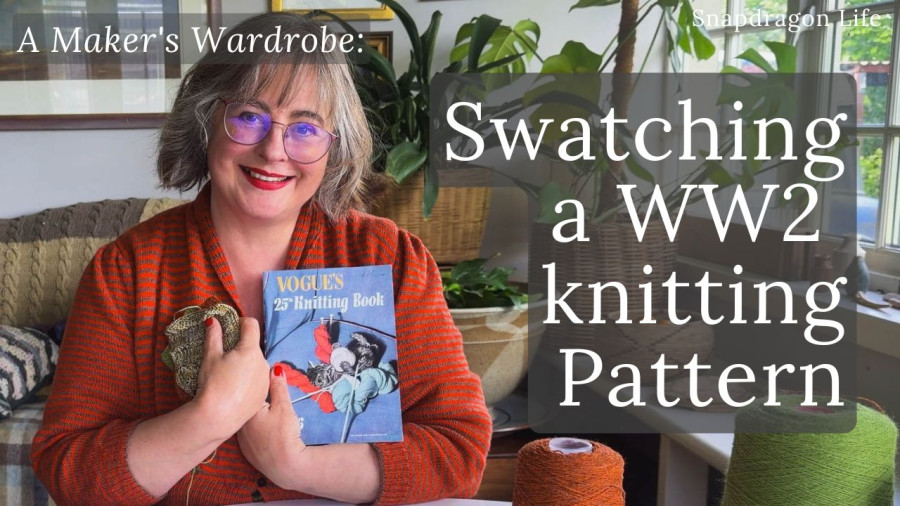
It is complete. It even has the buttons sewn on. It’s in the thumbnail!
The pattern is here in its original form.
You may also enjoy …
How to Dye Wool with Nettles
4 months ago
Dyeing wool with bracken - an experiment in changing the pH
Dyeing wool with bracken to get a range of colours by altering pH and modifying with iron
4 years ago
Getting back to making clothes
starting to making your own clothes, freehand machine embroidery
4 years ago
Dyeing wool with dahlia flowers
dyeing wool yarn with dahlia flowers, flowers for natural dyeing
4 years ago
 RSS
RSS