Journal
They Called It Matrons Wear: What 1950s Knitting Patterns Told Women to Be
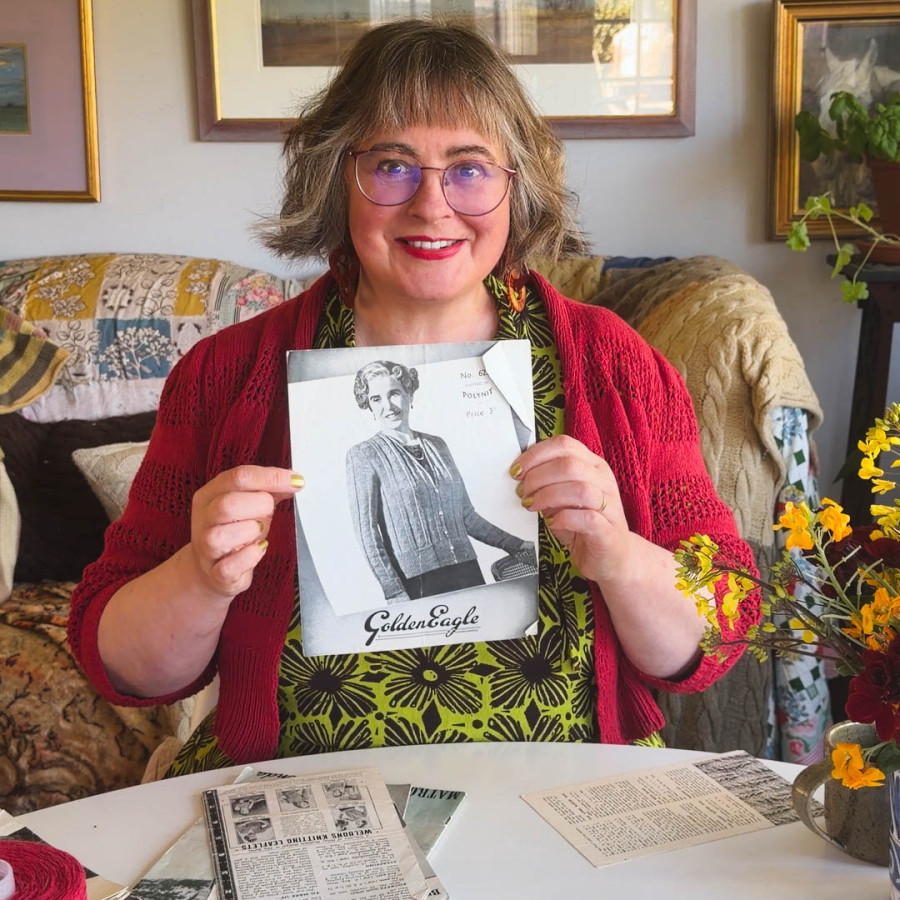
I needed a cardigan to go over a summer dress. That’s where this started.
The dress is a Toast folk print, a really rich brown base with bright reds, greens and yellows, and it’s fitted, with a side zip and a high neck. When I bought it I imagined wearing it like a pinafore, with stripy sleeves poking out underneath. But when I tried it on that way I looked, as I can only describe it, like a sausage roll. Trussed up. So I decided I needed something to go over it instead. Something lightweight. Not a woolly cardigan. A summer cardigan.
I had some very fine red cotton in my wool store, slightly dulled, which I love, and I thought I’d double it up and see what I could make with it.
Why a 1950s Pattern?
I’ve always been drawn to 1940s and 50s styling. It suits my shape. I have a waist, I have big hips, and that era of dressmaking understood that. Neat shaping. A defined silhouette. I like knitting with seams and from the bottom up, which I know makes me quite unusual in current knitting circles, but it’s how these older patterns work and I find them satisfying.
So I’ve been collecting original knitting magazines from that period. Not downloads, the actual magazines. When you hold the originals, you get so much more than just the pattern. You get a sense of how women fitted into society at the time. What they were expected to look like. What was considered suitable.
And that’s where things get interesting.
The 34 Inch Bust Problem
Most 1950s knitting patterns go up to a 34 inch bust. If you want to knit something vintage and you’re not a size 10, you run into a wall quite quickly.
This isn’t because women in the 1950s were all tiny. Look at photographs from the period and they clearly weren’t. What was happening was partly that women then knew how to redraft a pattern. They could take something sized for a 34 inch bust and rework it as they went for a 44 inch bust. That skill existed and was widely used. It’s largely gone now.
But there was also a separate category entirely. Patterns for what the magazines called the fuller figure. And these were marketed quite specifically at older women, described without any apparent irony as matrons.
Matrons Wear in Lavenda Wool
The book I found is published by Lister & Co, a Bradford wool company, and it’s called Matrons Wear in Lavenda Wool. One shilling and sixpence. There’s a woman on the cover who doesn’t look particularly matronly. She has pearls and a bunch of flowers. Inside, the patterns are named after castles and illustrated with little line drawings. Bed jackets. Sturdy-looking suits. And almost everything has that quality that Joyce Grenfell captured perfectly in her dance sketches: “stately as galleons”.
Corseted. Covered. Conservative.
You can feel the expectation in the styling. Under 40 and you’re shown in fitted sweaters, leaning back slightly, a little seductive. Over 40 and you become something else entirely. Battle dress, almost. The joy and colour and pictorial stitching that appears in the younger women’s patterns has largely vanished.
The Dress That Became a Cardigan
But tucked in among the stately galleons, I found this dress.
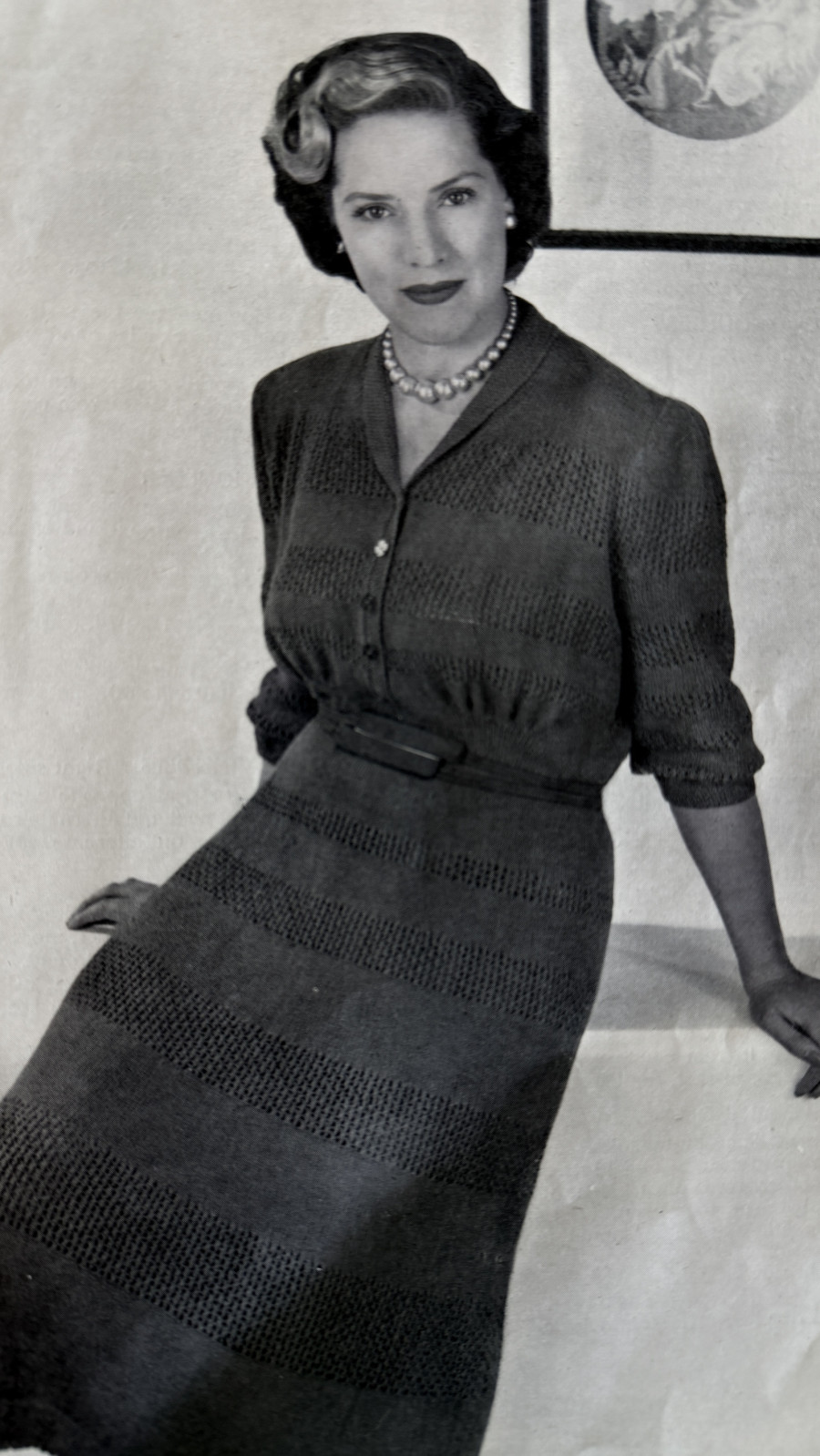
She does look quite foxy, the woman modelling it. It’s got lace panels in the skirt, three-quarter length sleeves, simple buttons at the top, neat shaping. And I thought: that would be exactly what I’m looking for if it were a cardigan.
So I adapted it. Instead of following the skirt, I added a deep single rib welt at the bottom. Everything else I kept largely as it was.
It’s a size 40 inch bust, uses 10 and 12 needles, and the original calls for Lavenda crochet wool. I used my fine, doubled red cotton instead.
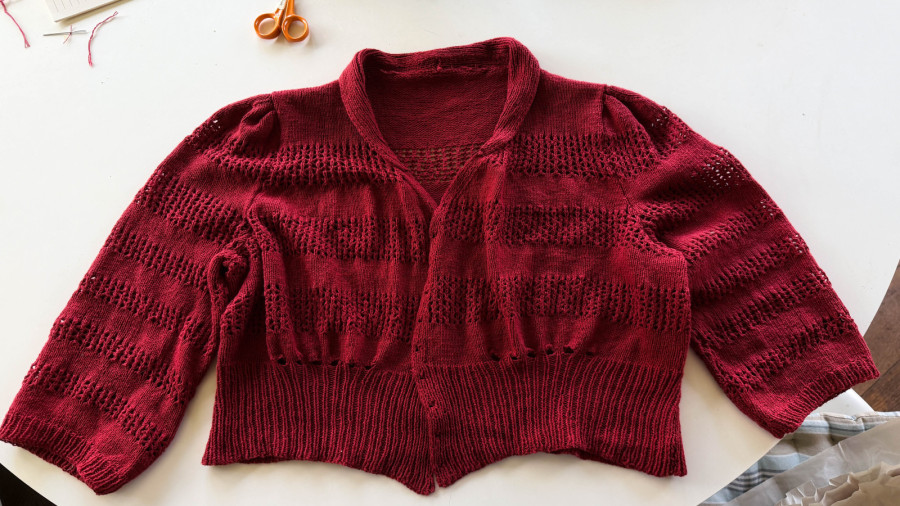
The result is very lightweight, you barely know you’re wearing it. It’s got the lace panels running through the body and into the sleeve, a gathered sleeve head that I’ve left without the shoulder pads the pattern calls for, and small buttonholes down the front. I’m actually not sure I’ll button it. I think it might just be nicer worn open, like a bolero.
It fits the dress perfectly.
I’ve also discovered it goes with most of the rest of my wardrobe. The slightly dulled red with a touch of black in it is very forgiving. People always say you can’t mix different reds together. I think they’re wrong.
What Happened to Older Women in These Patterns
Going through this collection, a pattern emerges. And I don’t mean a knitting pattern.
As soon as a woman in these magazines moves past a certain age, or a certain size, the styling becomes about containment. The brightness goes. The fancy stitching disappears. The message, if you read the patterns as a kind of text, is: now you dress like this.
It made me think about something we say quite easily now, that society wants middle-aged women to disappear. I understand why it feels that way. The media has always had a slightly fetishised relationship with youth. But I’m not sure general society is actually the problem.
I think some of it is something we do to ourselves. We stop wearing bright colours. We stop reaching for print and pattern and things that bring us joy in the way we might have done in our twenties. We absorb the message of the matrons wear.
And that’s the thing about being able to make your own clothes. Once you can do that, no one else gets to make that decision for you.
What the Knitting Community Got Right
Over the past twenty years or so, the knitting community has been genuinely at the forefront of changing this. Size inclusivity, age inclusivity, the idea that you can make and wear whatever you like, these aren’t just words in knitting circles, they’re real practices. Designers publishing full size ranges. Makers sharing photos of themselves in things that don’t look like battle dress.
I get messages on this channel from people who describe me as their favourite old person, which I find rather funny and also quite touching. I’m not sure I’m old yet. But I’ll take it.
Visible or invisible, both are entirely valid choices. But if you want to make things, and you want to make things that are yours, you can. You can take a 1950s dress pattern for the fuller figure and turn it into a cardigan. You can use red cotton instead of lavender wool. You can leave the shoulder pads out and the buttons undone.
The pattern as a starting point, not a set of instructions about who you are.
The Pattern
I’ve scanned the original pattern from the Lavenda book and put it here. I adapted it from a dress by casting on the 133 stitches for the back and knitting 4 inches of single rib and then following the pattern exactly. The pattern has the fronts joined together with a waistband and worked in two parts from that. I separated them, casting on 66 stitches, working 4 inches of rib and then P28 (cast on 6 sts., P3) six times, P11, (p1,k1) three times. I made the button band single rib rather than moss stitch.
It’s out of copyright. It’s yours if you want it.
You may also enjoy …
Making a Quilted Envelope Bag: A Slow Stitching Project in Vintage Linen
Discover the story behind a slow-stitched quilted envelope bag made with vintage linen, wool, and thread — a tactile project rooted in memory.
1 year ago
Making a Knitted Soap Saver
free patterns for making a soap saving mitt
7 years ago
Scotch broom as a dye plant
dying wool with scotch broom Cytisus scoparius
6 years ago
Natural Dyeing with Buddleia: How to Get a Rich Gold from Garden Weeds
Buddleia gives a warm old-gold yellow on pre-mordanted wool and it costs nothing to collect. Here's the whole process, from spent flowers to finished skein.
5 months ago
 RSS
RSS