Journal
Being fully where you are
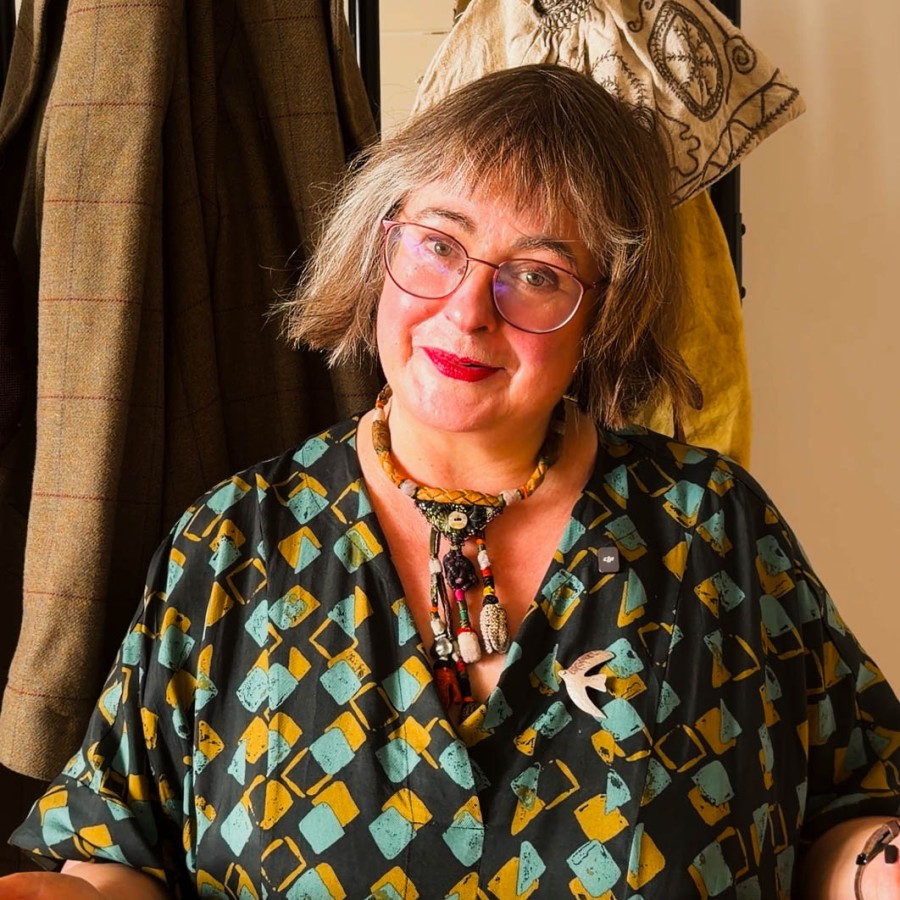
Every February I leave rural Scotland and move to Naples for a month. Not on holiday. I take my work with me, my laptop and my phone, and I just... relocate. I rent an apartment with a balcony looking out over the bay, and I do exactly the same work I’d be doing at home, just somewhere else.
People find this confusing. I live in Stirlingshire, gateway to the Highlands, about five minutes from Loch Lomond. My studio is in a meadow that runs down to a little wood. There are deer and buzzards and hares. It is exactly the kind of place the wellness industry tells us we should all be heading towards. And I leave it for one of the most chaotic cities in Europe.
I’ve started calling it my silent retreat, which gets even more confused looks.
What I’m actually doing there
The trip isn’t about Naples specifically, though I love it. It’s about what happens when I strip away all the layers I’ve built up during the year.
Because that’s what happens, gradually.As news gets more distressing, social media gets more toxic, the world feels more overwhelming, and without quite noticing, I start to cocoon. I fill every gap. Cooking with an audiobook on headphones. Walking with a podcast. Checking emails in every spare moment. I get busy for the sake of busyness. I layer on noise and distraction until there’s no space left for anything to get in.
We are not made for 24-hour rolling news. We’re village-gossip-level creatures. We can’t have the whole world’s horror beamed into us without it doing harm. And yet we pile it on, and then pile on more noise to cope with it.
It feels like protection. It is protection, of a sort. But it comes at a cost.
The cost of cocooning
When you armour yourself against the difficult things, you also armour yourself against the good things. You stop noticing. Colour, light, the way a street looks at a particular time of day, the smell of coffee from a doorway. All of that gets muffled along with the horror.
And there’s a wider cost too. Research consistently shows that people who doom-scroll most are actually the least able to help. They don’t have the spare capacity, whether that’s political engagement, financial giving, or simply time. So the very thing that feels like engagement with the world’s problems is actually pulling people further from being able to do anything useful about them.
Taking the armour off isn’t about ignoring what’s happening in the world. It’s about being in a state where you can actually respond to it.
Why a chaotic city works
This is where it gets interesting, because the wellness industry has sold us a very specific story: that restoration means nature, silence, escape. Get to the countryside. Walk in the woods. Find somewhere quiet.
I’m not arguing against any of that. But I am saying it’s not the whole picture. The assumption that cities are depleting while nature is healing doesn’t hold up when you look at the research.
It turns out that what actually restores us isn’t silence or greenery per se. It’s a particular quality of attention that psychologists call soft fascination. This is when things come to you gently, without demanding anything. Waves on a shore. Leaves moving in wind. Washing hanging on a line. A dog sitting on a doorstep. People having coffee at a pavement table. These things give your brain just enough stimulation to be occupied without being overwhelmed, and that’s what allows it to rest and open up.
This is the opposite of rolling news, where one disaster follows another follows a fight. Soft fascination is calm. It comes to you. You don’t have to seek it out.
And crucially, this happens in cities as well as in countryside. Sometimes better.
What the research actually says
I went looking for evidence because I wanted to know whether my experience of Naples as genuinely restorative was just personal preference or something more. What I found surprised me.
There’s a significant body of research, mostly from town planning and environmental psychology rather than the wellness industry, that challenges the idea that nature is uniquely restorative.
A 2013 study by Lindal and Hartig looked at residential streetscapes and found that architectural variation (different building heights, varied facades, surface ornamentation) had a larger effect on people’s sense of restoration than vegetation did. Architecture mattered more than greenery.
Wang and colleagues, in 2023, found that historical buildings scored highest on what researchers call the “fascination dimension,” that quality of holding your attention gently. The rich facades of old buildings, the cultural layering, the sense of time passing through a place: all of this had measurable restorative effects.
A 2008 study by Karmanov and Hamel directly compared urban and natural environments and found that a well-designed city space could have stress-reducing power equal to an attractive natural one.
And a 2021 review by Subiza-Pérez and colleagues concluded that “the typical dichotomy between low restorative built environments and high restorative natural environments needs re-examination.” Historic interiors and courtyards showed restorative potential similar to natural settings.
None of this means nature isn’t good for us. Of course it is. But it does mean that the story we’ve been told, that you need to escape to the countryside to feel restored, is incomplete at best and actively unhelpful for a lot of people.
The elitism problem
This matters because “get out into nature” isn’t available to everyone. Not everyone has access to countryside. Not everyone can afford a retreat. Not everyone lives near green space, and even where parks exist, they’re not always the peaceful havens the wellness industry imagines. The park near my Naples apartment is mostly closed, full of litter, and not remotely restorative.
But almost everyone has access to a street where things are happening. A café where you can sit and watch people. A market. A walk through a neighbourhood with different buildings and doorways and life unfolding.
Telling people that wellness requires nature, and specifically rural nature, creates a gap between what people are told they need and what they actually have. It makes ordinary life feel inadequate. And it isn’t true.
What Naples gives me
Naples works for me because it’s impossible to cocoon there. The traffic alone requires you to pay attention. There appear to be no rules, certainly no markings on the roads, and scooters swerve between cars at speed. In practice, pedestrians are king. If I walk out onto a road, cars will either stop or go around me. But it doesn’t feel like that. You would not wander around with headphones on.
Beyond the traffic, it’s a city of extraordinary texture. Around every corner there’s something. Washing strung between buildings. Shrines tucked into walls. Markets spilling onto pavements. Dogs sitting on chairs. Coffee shops where you can sit and watch it all unfold. None of it is asking for my attention in the way a notification or an algorithm does. It’s just there, and if I’m open to it, it comes in.
After a few days I notice my attention changing. I start off photographing the obvious things: the views, the processions, the washing lines. But soon I’m taking pictures of damp on walls, grass pushing through drains, the colour of a fishing net in a plastic bin. My brain has opened up. I’m noticing beauty in things I’d normally walk straight past.
That’s what soft fascination does. That’s what taking the armour off feels like.
You don’t need Naples
I appreciate that moving to Italy for a month is not available to most people, and that’s not what I’m suggesting. The point is that the practice works anywhere. Deliberately removing layers of noise and distraction. Going out without headphones. Walking slowly. Letting things come to you.
Your street has things worth noticing. Your local café has people worth watching. The buildings you walk past every day have details you’ve never registered. Tate Modern in London is free, and you can go in, find a seat, and just watch people move around the space. That is soft fascination in practice.
Start small. Take a walk without your headphones. Accept that it might feel uncomfortable. It probably will, because you put the armour on for a reason. But try it and see what you notice.
It’s good for your creativity. But actually, I think it’s bigger than creativity. It’s about being properly alive to the world you’re living in.
This blog accompanies my Friday Film “Why Naples?”
I’m Jane, and I run The Studio, an online creative membership for women who want to slow down and make with intention. If what I’ve been talking about here sounds like something you need, you can find out more
Sources
1. Lindal & Hartig (2013) - Architecture > vegetation: https://www.researchgate.net/publication/257104788_Architectural_variation_building_height_and_the_restorative_quality_of_Urban_residential_streetscapes
2. Wang et al. (2023) - Historical buildings highly restorative: https://www.frontiersin.org/journals/psychology/articles/10.3389/fpsyg.2023.1132052/full
3. Subiza-Pérez et al. (2021) - Challenging the dichotomy: https://www.frontiersin.org/journals/psychology/articles/10.3389/fpsyg.2021.717116/full
4. Weber & Trojan (2018) - Systematic review: https://pmc.ncbi.nlm.nih.gov/articles/PMC6256310/ OR: https://bioone.org/journals/environmental-health-insights/volume-12/issue-1/1178630218812805/The-Restorative-Value-of-the-Urban-Environment--A-Systematic/10.1177/1178630218812805.full
5. Karmanov & Hamel (2008) - Urban equal to nature: https://www.researchgate.net/publication/223433110_Assessing_the_restorative_potential_of_contemporary_urban_environments_Beyond_the_nature_versus_urban_dichotomy
You may also enjoy …
How I worked from Naples for a month
how I work while travelling digital nomad
1 year ago
Forcing spring branches
How to force spring branches
4 years ago
Visible mending on a knitted jumper
creative visible mending of jumper, wool darning, sustainable fashion
3 years ago
3 ideas for getting into the flow
3 ways to increase the flow in your life
7 years ago
 RSS
RSS