Journal
A Remarkable Textile Exhibition in Paris (On Until July 2026)
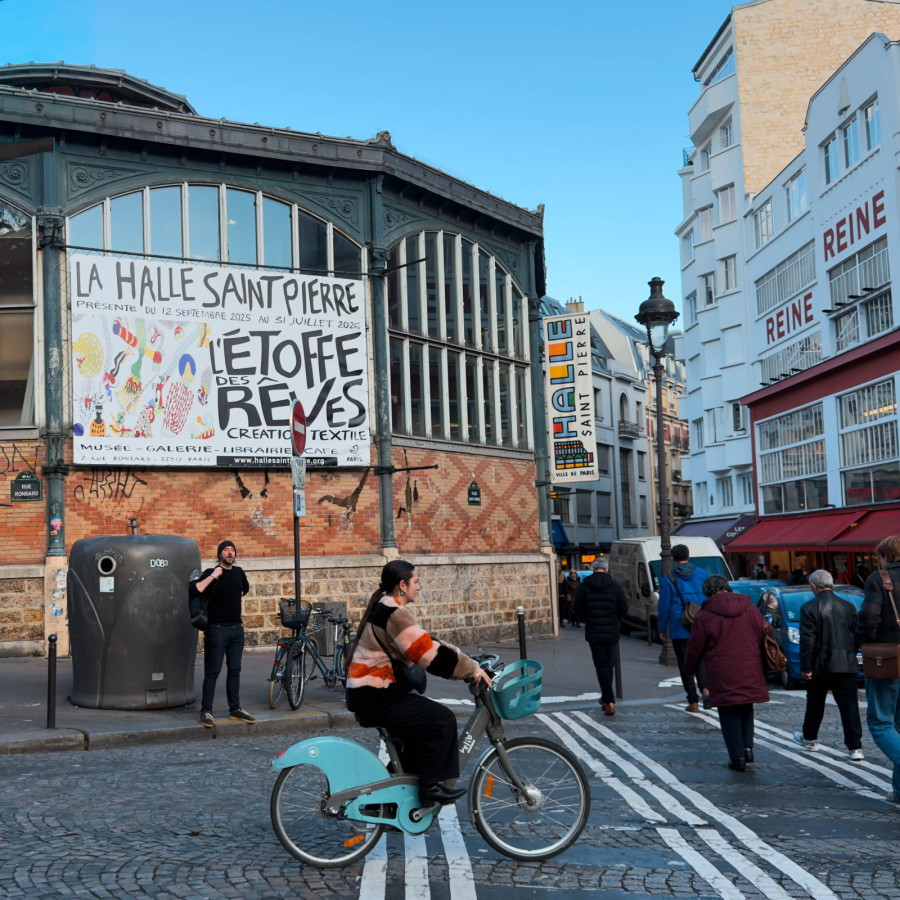
I ended up in Paris rather by accident. I’d flown to Naples and decided to come back by train: Naples to Turin, Turin to Paris, then through the Channel Tunnel to London. Two days in Paris meant I could see several exhibitions, and one of them was at the Halle Saint-Pierre in Montmartre.
I want to mention the space itself before I get to the work. The Halle Saint-Pierre is an outsider art space: folk art, art brut, things that exist outside the main establishment. It sits in the middle of Paris’s textile district about 5 minutes from Montmartre, it is surrounded by shops selling fabrics, yarns, buttons, zips. And the space itself felt genuinely alive. The bookshop was full. The library was full. The café was busy, there were people having head massages, workshops clearly running. It’s the kind of art space we all want more of.
At the moment, right through to the end of July 2026, they have an exhibition called L’Étoffe des rêves (The Stuff of Dreams). Thirty-six textile artists, two floors of work. It’s extraordinary and, honestly, quite overwhelming. I could only take in so much.
So rather than attempt all thirty-six, I want to tell you about three artists whose work stopped me.
Lili Simon
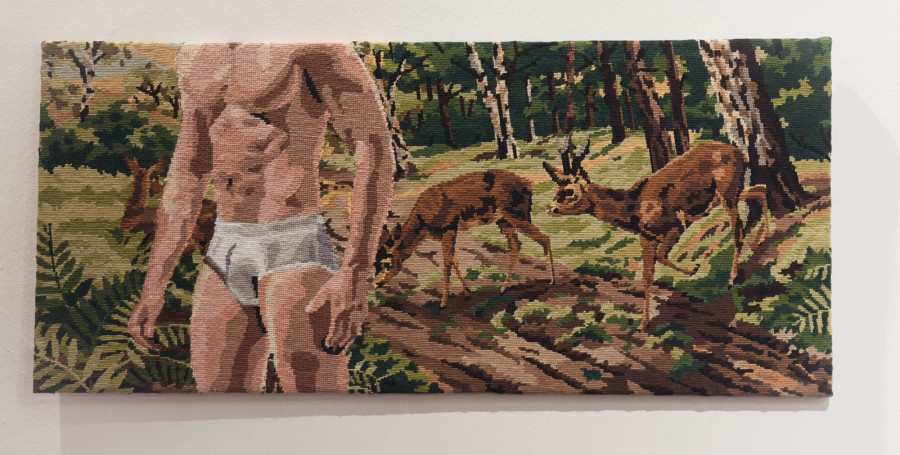
Lili Simon was born in Alsace in 1980. She trained at the Beaux-Arts but her practice has always been more outsider than establishment, taking magazines, catalogues, adverts and subverting them, poking fun at them.
During lockdown, she became interested in needlepoint and started thinking about those very camp, kitsch landscape canvases from the 1960s and 70s. The deer, the mountains, the idealised coastal scenes. Women spending hundreds of hours on these complicated pieces, sitting and thinking. And she started wondering: what are their fantasies? We talk endlessly about the male gaze. But when a woman is sitting stitching for hours and hours, what is she looking at in her mind’s eye?
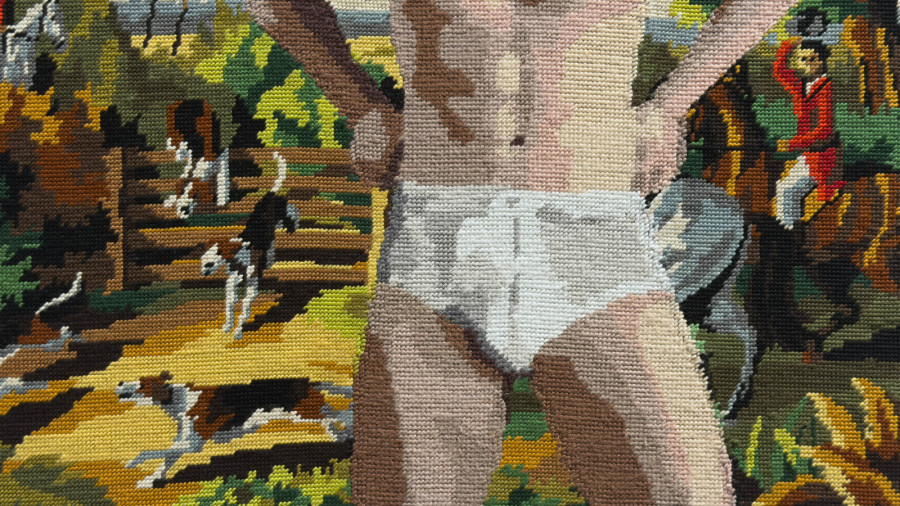
Lili Simon took some adverts featuring men in their underwear (the Calvin Klein kind of aesthetic) and inserted them into the canvases.
She did this in two ways. In some pieces she has carefully unpicked the original stitches and restitched over them to create her figure. In others she has cut the original needlepoint, made a new panel, and sewn it in. Very different techniques, quite different results.
I found them very funny. Understated. And it occurred to me that this is also a genuine technique for craft activism: taking an existing textile object and replacing elements of it with something entirely unexpected.
Aurélia Jaubert
Aurélia Jaubert was born in 1967 and grew up in a household where looking carefully at things mattered. Her mother, Marie-José Jaubert, wrote La Mer assassinée in 1978, a book documenting pollution along the French coastline. Her father, Alain Jaubert, spent his career making documentary films about how to look closely at paintings. That’s the kind of household this is.
She began her big tapestry works in 2017, after years of collecting old needlepoints from car boot sales and flea markets. She has always found them a bit naff, she says, and also beautiful, and also important. Because all of that needlework corresponds to a condition of women. Right up into the 1950s, there were books about how to be a good housewife and how to occupy your leisure time.
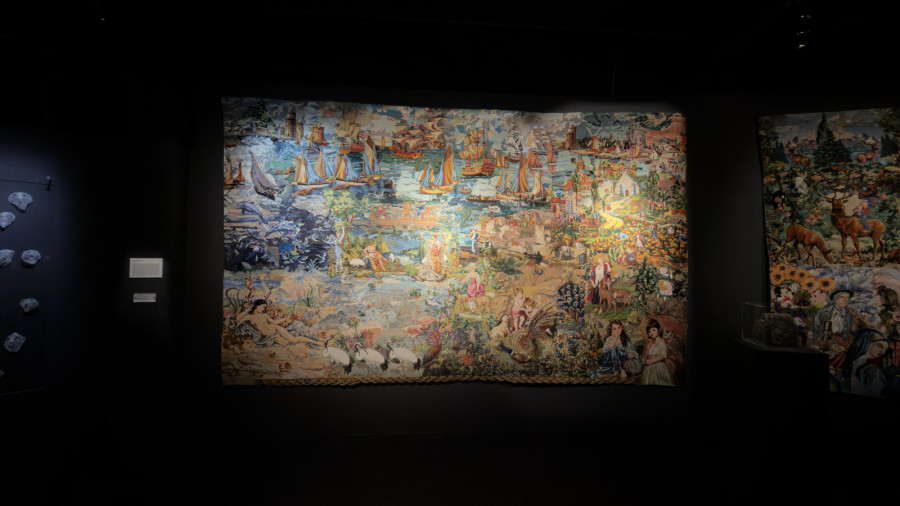
Her ambition from the start was to take all of those small domestic pieces and make something monumental from them, something on the scale of a medieval or Renaissance tapestry, with a foreground, a middle ground, a background, figures, and stories.
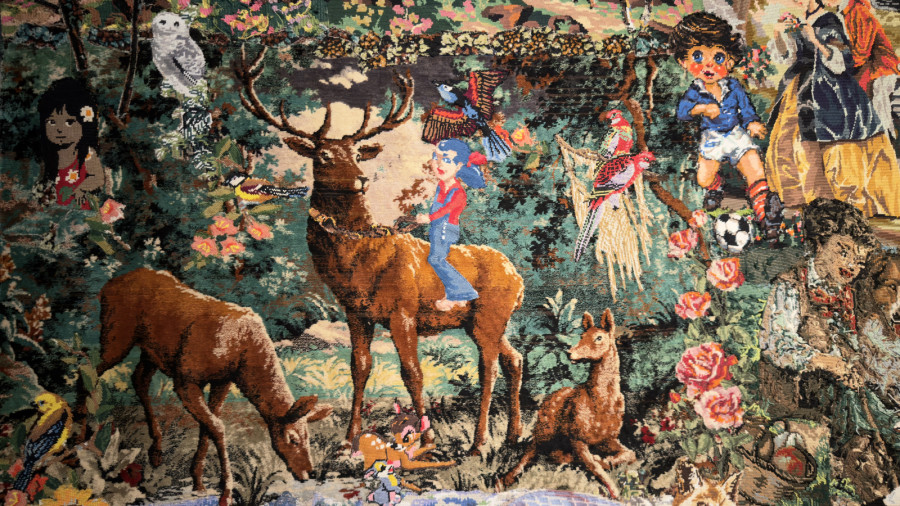
The two works at the Halle Saint-Pierre took up an entire wall. They are extraordinary. There is so much to look at: hunting scenes, women in crinolines, classical figures, animals, all assembled from pieces that might span a hundred years of women’s making. She also uses the backs of some sections deliberately, so you see the workings, something like a pencil sketch showing through, which softens the weight of it all slightly.
People were standing in front of these for a long time.
There is a short film on YouTube of Aurélia working in her studio: cutting needlepoints, assembling pieces, walking round and round the work. It’s worth watching.
Shao Liyu Chen
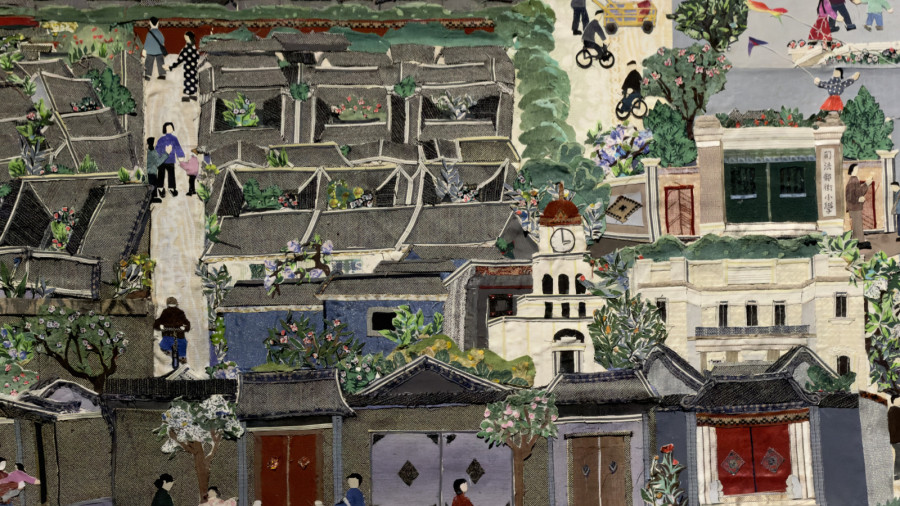
Shao Liyu Chen was born in Beijing in 1946. She grew up in a traditional courtyard house in the heart of old Beijing, in the hutongs, the network of alleyways that ran through the old city. She went to university, became a professor of philosophy, and in the early 1980s her husband left for Paris to study contemporary art. She joined him five years later.
In Paris, she and her husband moved through museums and galleries, absorbing Western art. She began working for a French interiors company, bridging Chinese and Western aesthetics. And then she made a return visit to Beijing and found that the city of her childhood had been largely demolished. Modern towers had replaced the hutongs. The courtyards were gone.
She came back to France and began to make collages. Everything in the exhibition came from her own collection: these pieces were never for sale, never intended for galleries. They are made from tiny scraps of fabric, assembled into dense, teeming cityscapes and landscapes of a Beijing that no longer exists.
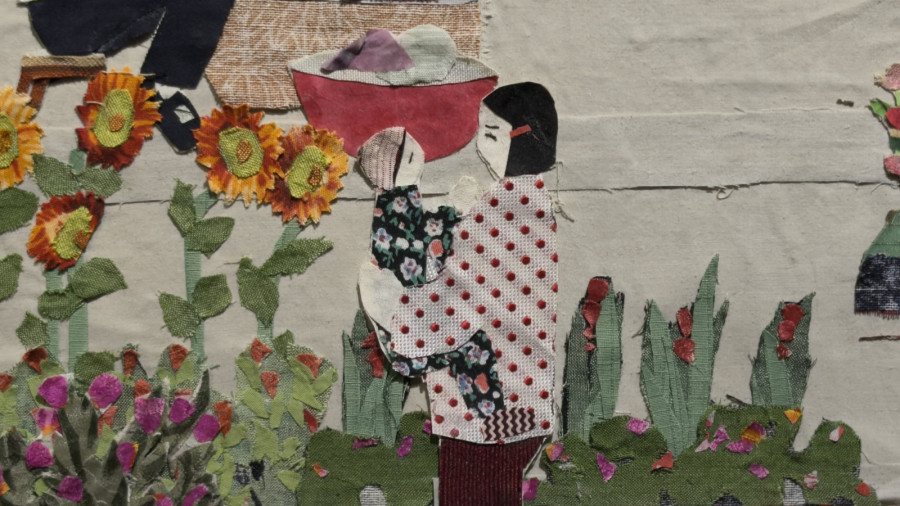
The level of detail is remarkable. People stood in front of these for a long time too, finding things: a bicycle, a fire, a dog, a cart. Made from the smallest fragments of cloth.
She is nearly eighty. She came to this work in her forties, after a career in philosophy and cultural work. Everything in the exhibition belongs to her personally. That felt significant.
Why these three
These are by no means the only artists worth seeing in this exhibition. But they are the three that connected most directly to conversations I find happening all the time in The Studio: about repurposed work, about the labour of women, about memory, about what we do with the small scraps of things we accumulate and don’t quite know what to do with.
If you have old needlepoints piling up. If you have a bag of tiny fabric scraps. If you’re wondering what those things are actually for, this exhibition has something to say about that.
The Halle Saint-Pierre, 2 rue Ronsard, Paris 18th. L’Étoffe des rêves runs until 31 July 2026. Open Monday–Friday 11am–6pm, Saturday 11am–7pm, Sunday 12pm–6pm.
You may also enjoy …
The Problem with “Play” in Creativity (And What It Actually Means)
When perfectionism stops you making, everyone says 'just play.' But what does that actually mean? A different take on creative play from The Studio community.
2 months ago
Natural Dyeing: Flag iris root part two
dyeing wool with flag iris roots historic dye
3 years ago
Common Farm Flowers -
common farm flowers
10 years ago
Studio Club Zoom chat with Ruby Coupe; aka Dotty Delightful
Nature, Creativity and Magic (and a lot of just getting on with things)
1 year ago
 RSS
RSS