Journal
A 1912 Bathing Suit, and the Women Behind Its Label
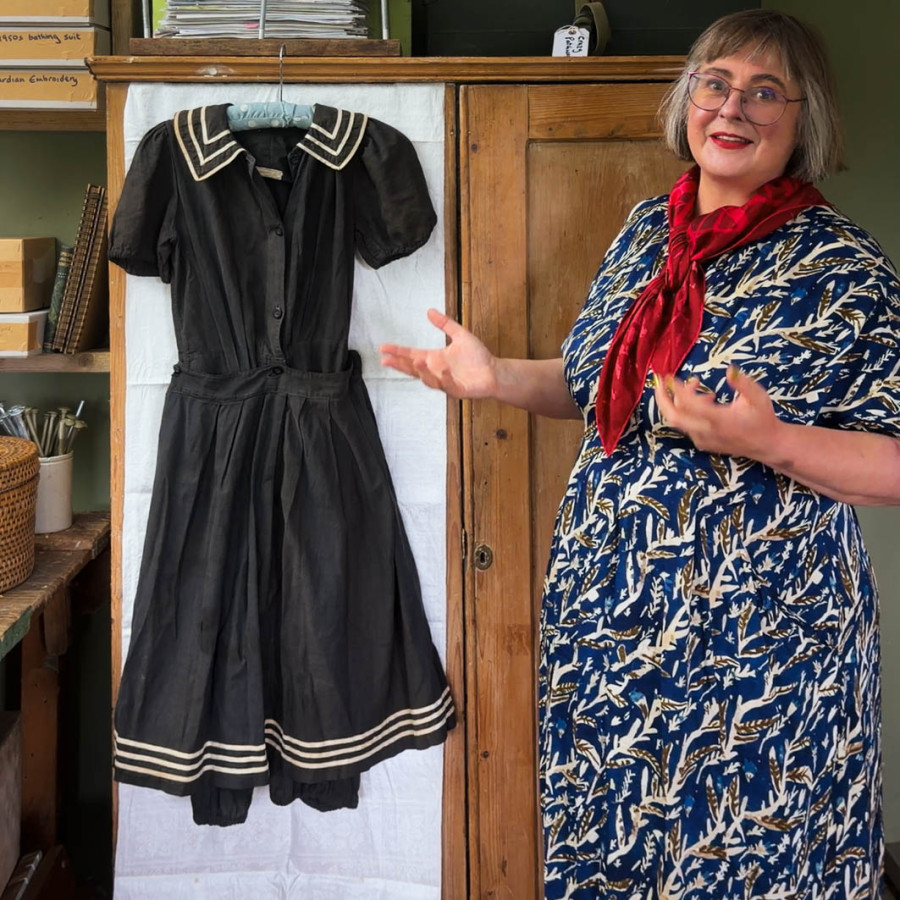
When this bathing suit came up for auction, two things pulled me towards it.
The first was simple. Everything I already had in the Studio textile collection from around this date is formal, upright, boned. Beautiful, but not built for movement. And this was exactly the period when women started becoming physically active for their own health and pleasure, not just as hard labour. Keep fit classes were starting. Women were playing golf, cricket, hockey, tennis, croquet. And they were swimming.
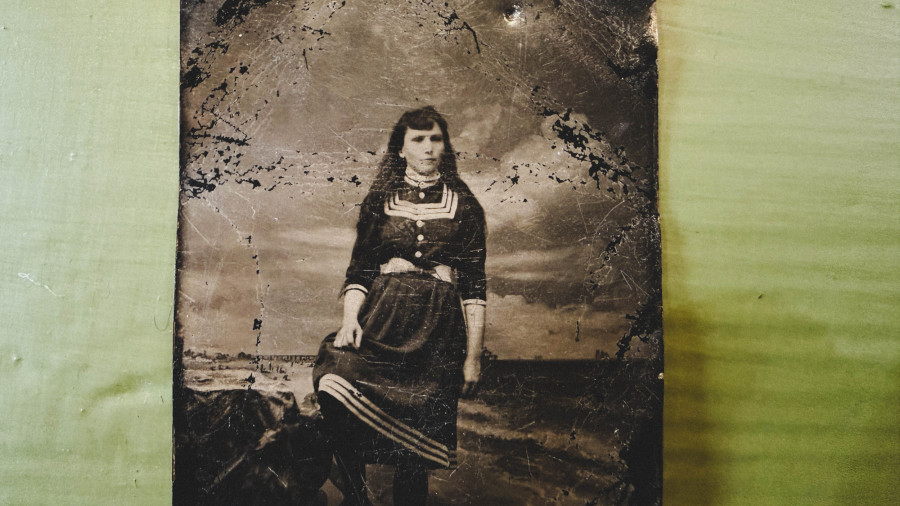
The second reason was a tintype I already owned, of an American teenager in a sailor suit, fierce-eyed, hair not yet up. The two garments share the same nautical language, though not a direct line between them. Both are American. Both spoke to me before I understood why.
The Object Itself
The suit is cotton, made in two parts. An underlying “romper” of bloomers and a buttoned top with puffed sleeves, and a detachable skirt that buttons onto the waistband separately. The skirt is 59 cm long, knee length, no more. Advice at the time was firm that a swimming skirt should never go below the knee, since a longer one could tangle round the legs in the water and cause real accidents.
The romper has a structured waist, not corseted, but shaped, fastening with buttons the full length of the front. A sailor collar at the neck carries three rows of braid, echoed in three more rows around the skirt hem. The crotch sits low, giving room to actually move and kick.
It has clearly been worn hard. There’s discolouration from repeated washing, a mended split that has torn open again, a smaller hole beside it. This wasn’t a suit bought and barely used. Someone swam in it, again and again.
Why Were Women So Covered Up in 1912?
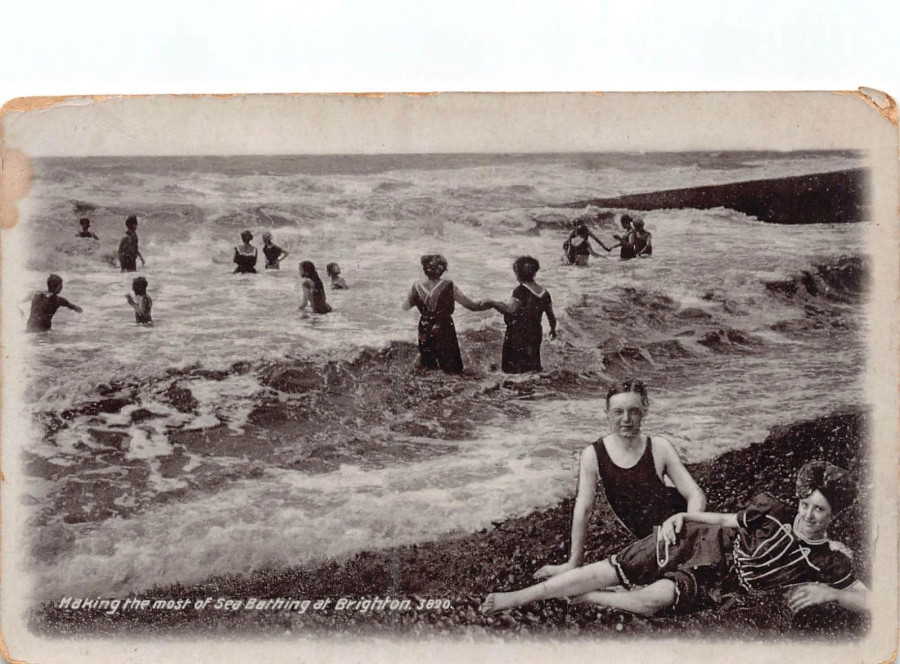
Most American seaside resorts at this date had local ordinances requiring women to be covered from shoulder to knee at the beach. This suit meets that standard precisely. Buying it wasn’t a personal choice towards modesty so much as the ordinary, legal way to be allowed onto the sand at all.
Britain didn’t run the same system. There was no equivalent state ordinance I’ve been able to find. Instead, bathing had traditionally been segregated by sex, separate beach areas, bathing machines wheeled into deeper water so a woman went straight from steps to sea without a public walk down the beach. Within that segregated world, dress could be more relaxed, since men simply weren’t there to see it. Once mixed bathing became normal in the new century, etiquette and social convention did the work that law did in America.
Either way, coming out of the sea in heavy wet cotton like this must have been thoroughly unpleasant. Getting changed in it, harder still. I suspect a good deal of sitting on the beach afterwards, letting it dry.
The Label
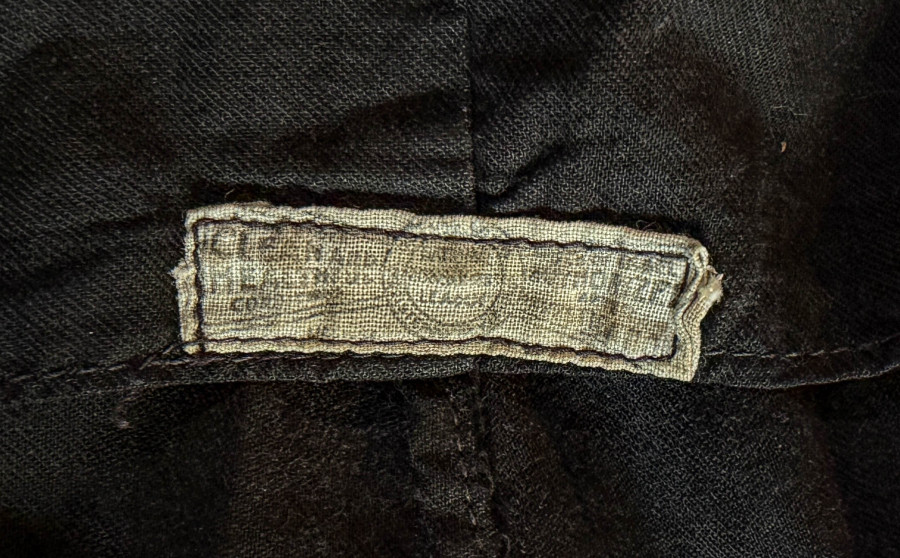
There’s no maker’s label in this suit. It was ordinary, commercially made clothing. But sewn into the back of the neck is something else entirely: a small printed label reading “Clean and Healthful Condition. National Consumers’ League. Use of label authorized after investigation.”
The National Consumers’ League began in New York around 1899, growing out of an earlier local scheme where shops that treated their women workers decently could display a small white sign. The idea then went national. Factories were inspected, checked for fair hours, safe conditions, no child labour, and only then could their goods carry this white label, giving women buying clothes the information to make an informed, ethical choice.
The League was founded by Jane Addams and Josephine Shaw Lowell, and led for over three decades by Florence Kelley, a Hull House worker and former Illinois factory inspector who went on to help found the NAACP. Three women, working specifically to improve conditions for other women, using the ordinary act of buying clothes as their lever.
So this suit is holding two stories at once. A woman who wanted to swim properly, to be outdoors and active on her own terms. And, stitched into the same cotton, evidence of women organising to protect the women who made it. Neither story needs the other to be interesting. They just happen to share the same piece of clothing.
More on the National Consumers’ League, its founders, and how the white label campaign worked is in the film above.
You may also enjoy …
Time for an introduction
Introduction to Jane Lindsey of Snapdragon Life
2 years ago
Who Wore This? Reading a Costume With a Dress Historian
I sat down with dress historian Robyne Calvert to look properly at two garments from my own collection, and to ask what looking properly even means.
6 days ago
What Andy Goldsworthy’s Ferns Taught Me About Seeing
Ferns at The Royal Scottish Academy, Edinburgh
11 months ago
Rag Rugs, Remembered: Creativity, Memory, and the Quiet Legacy of Women’s Work
Explore how rag rugs, Winifred Nicholson’s vision, and everyday women’s handiwork reveal a deeper story of creativity, care, and the domestic arts.
1 year ago
 RSS
RSS