Journal
Townsend’s Monthly Selection of Parisian Costumes, November 1830
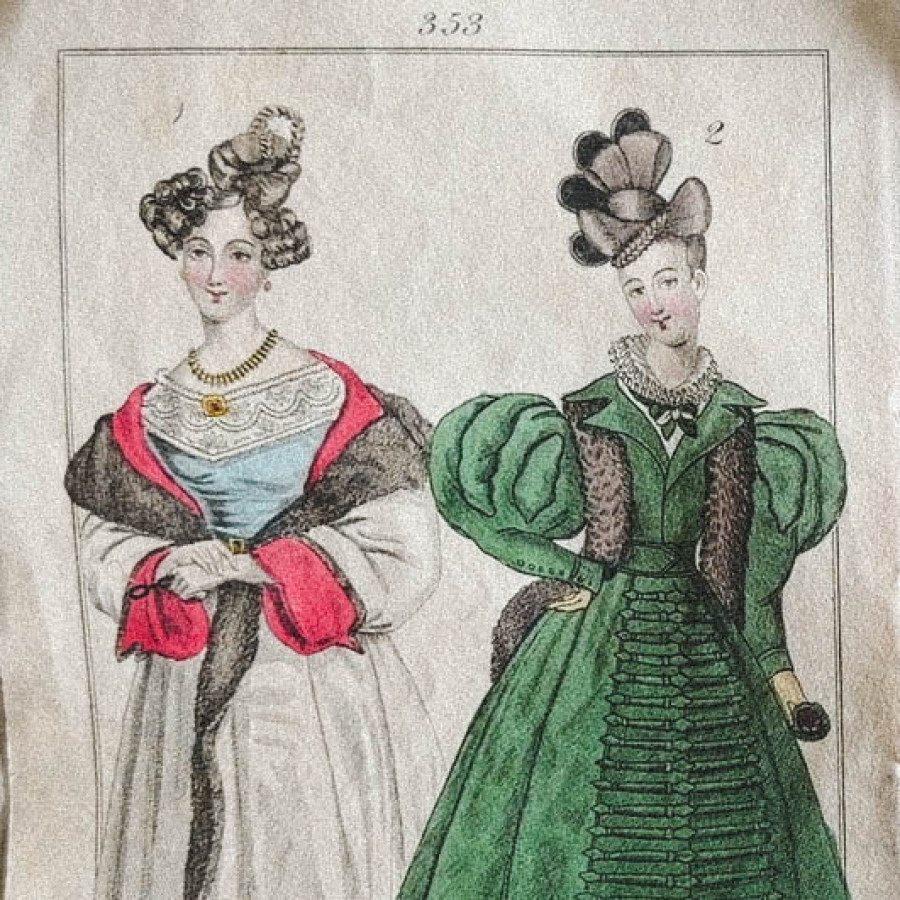
What Townsend’s Monthly Selection was
Townsend’s Monthly Selection of Parisian Costumes was a London fashion periodical, published monthly, with each issue built around seven hand-coloured plates and a short description of the dresses shown. My copy is No. LXXI, November 1830, priced at eighteen-pence.
It was published from 11 Jermyn Street, just off Regent Street, by J. Townsend, with other names named on the title page too: C.S. Arnold in Covent Garden, Simpkin and Marshall in Stationers’ Hall Court. The magazine was proud of how current it was. It claimed to receive a weekly packet from Paris and to publish nothing that hadn’t appeared there within the preceding month.
Not just a London thing
What I find genuinely interesting is how far this reached. The title page also lists John Anderson in Edinburgh and Richard Milliken and Son in Dublin as sellers, and the magazine itself invited country readers to order through any local bookseller “or clerk of the road,” at no extra cost, so they’d get each issue as soon as it was published. This wasn’t a London curiosity. It was built, from the start, to reach women right across the United Kingdom, wanting the latest Parisian fashion news without ever leaving home.
The adverts
Adverts sit at both the front and back of the issue, and together they take up close to half the magazine. Milliners and dressmakers advertise their businesses, several of them making a point of having “just returned from Paris” with new stock, which tells you something about how authenticity was sold in this trade. There’s a corset maker listing named physicians as endorsers. There’s even a millinery business quietly up for sale, the proprietor “retiring in consequence of ill health,” handled entirely through an agent rather than in her own name.
What I really love, though, is a long, breathless advert for an “Improved Peruke,” essentially artificial hair, aimed at both men and women who wanted to build those enormous, elaborately ringletted styles of the period without it ever looking obviously false or coming loose. It sits on the page next to remedies for sallow skin and cures for hair falling out. Fashion, beauty quackery, and outright vanity products were sold side by side in the same pages, to the same readers.
What the plates were actually for
The plates weren’t just pictures to admire. They came with detailed written descriptions of the fabric, the trimming, the construction, and this is presumably exactly what a woman would take to her own dressmaker. You didn’t need to travel to Paris to get a Parisian dress. You needed eighteen-pence, a subscription, and someone locally who could sew.
It helps to put eighteen-pence into real terms. Before decimal currency, twelve pence made a shilling, and twenty shillings made a pound. Eighteen-pence was one shilling and sixpence.
Elizabeth Gaskell’s Cranford gives a useful yardstick as it is precise on money. It was published in the early 1850s but set at the beginning of the 1840s, so it takes place a decade after this magazine.
Miss Matty in the novel initially has an income of £150 a year, close to £3 a week to run her whole household in what she saw as a frugal but genteel way.. Against that, eighteen-pence for a fashion magazine was the kind of small luxury a careful woman could just about justify as part of her “elegant economy”.
After the disastrous collapse of the bank which handled her savings, she was left with just over £1 a month to live on - which is 60 pre-decimal pence a week (or three and a bit copies of the magazine).
Interestingly this reduced circumstance would put her right in the middle of the amount a full time seamstress would expect to earn - that was the income of the women looking at and sewing up copies of the dresses.
A few terms, explained
The plate descriptions and fashion notes use words that aren’t in everyday use now. Here’s what the main ones mean.
Amadis – a long, close-fitting sleeve, named after a character in a French romance.
Bobbin-net – a machine-made net fabric, cheaper than the handmade lace it was designed to imitate.
Bouffant – puffed or gathered out, usually describing a sleeve.
Canezou – a short, sleeveless bodice or spencer, worn over a dress.
Capote – a bonnet with a soft fabric crown and a stiffened brim.
Coiffure – a hairstyle, or a headdress built into the hair.
Corsage – the bodice of a dress.
Crape – a crimped, matte silk or wool fabric, often used for mourning wear but not exclusively.
Douillet – literally “cosy” or “soft” in French; a padded or quilted style of dress or wrap.
Foulard – a lightweight, soft silk fabric.
Gros de Naples – a heavy, plain-woven silk, one of the most common dress silks of the period.
Jaconot – a fine, lightweight cotton muslin.
Liseré – a decorative edging or piping, often in a contrasting colour.
Pelerine – a cape-like collar covering the shoulders, often with long ends hanging at the front.
Pelisse – a long coat-like garment, usually fastened all the way down the front.
Sabot sleeve – a sleeve wide at the top and narrowing sharply toward the wrist, named for its resemblance to a wooden clog.
Toque – a soft, brimless hat.
Velours épingle – uncut velvet, meaning the loops of pile are left whole rather than sheared, giving a slightly ribbed surface.
Studio members who are logged in can see the full set of photographs of every page of this issue further down this post.
Members only …
The rest of this post is only accessible to members.
 RSS
RSS