Journal
My Garden in May: Why Looking at Nature Changes How You Feel
In 1984, a researcher called Roger Ulrich published a study in Science that was, at the time, quietly remarkable. He looked at the medical records of patients recovering from gallbladder surgery at a hospital in Pennsylvania. Some of them had rooms with windows facing trees. Others had rooms with windows facing a brick wall. That was the only difference.
The patients with tree views recovered, on average, a day faster than those looking at the wall. They needed fewer painkillers. They had fewer post-surgical complications.
A view of trees was the only change.
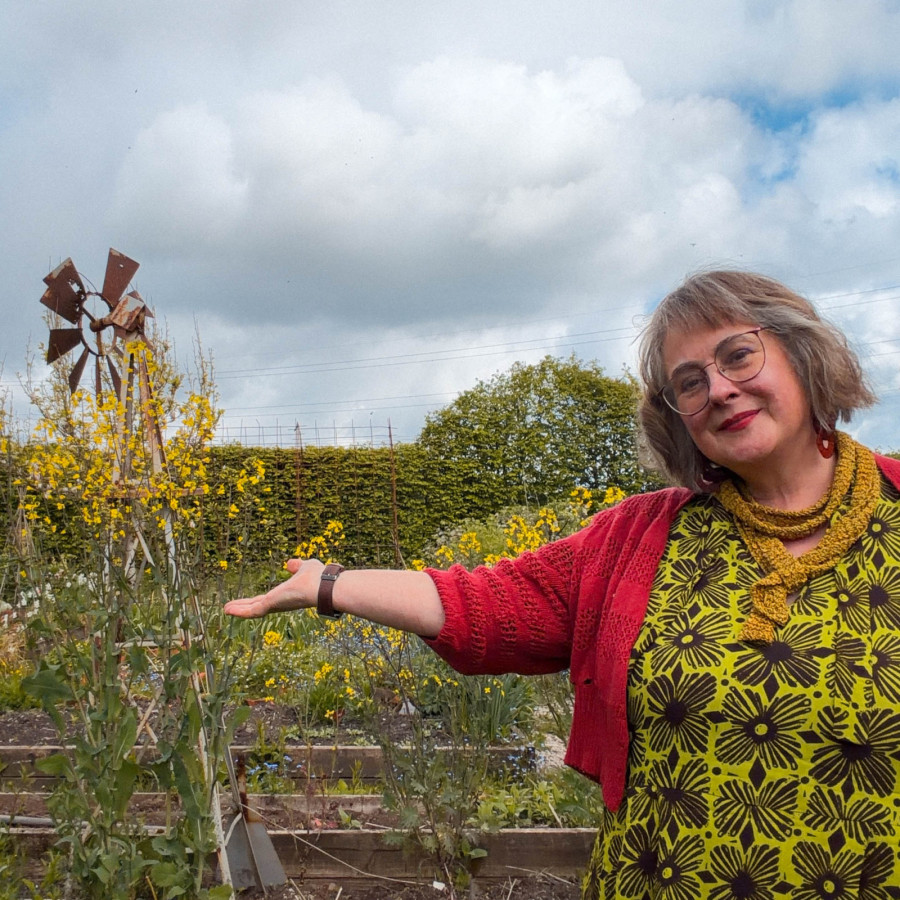
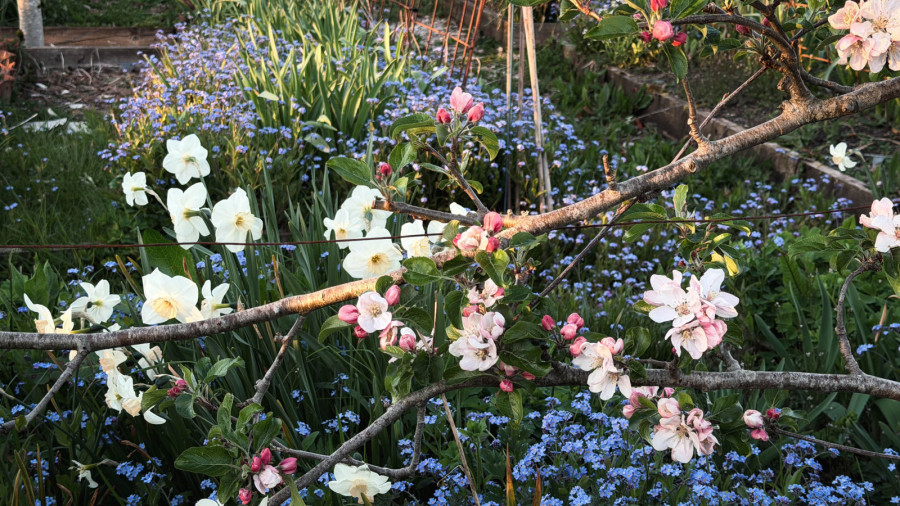
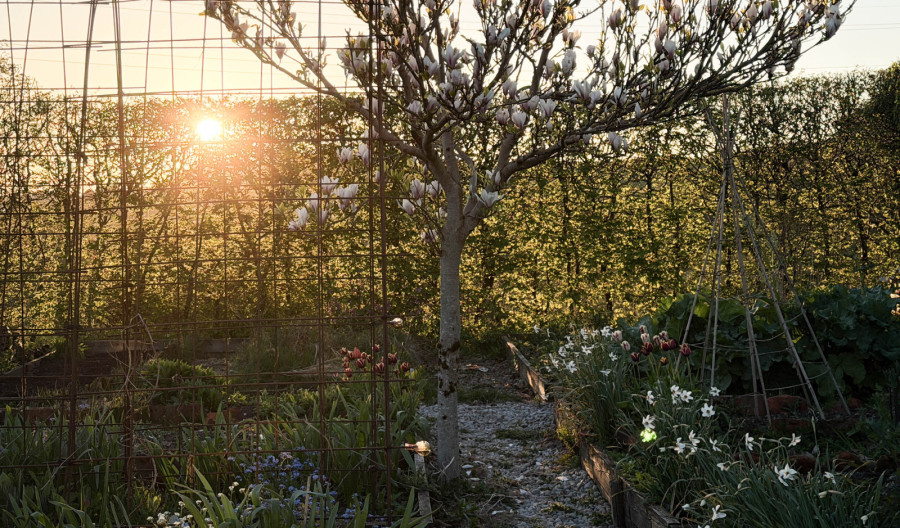
In this week’s film I take you round my garden in May — no thriller music, no manufactured peril, just the birds and the magnolia and some thoughts on all of the above.
What the research actually shows
Ulrich’s study opened a door. Subsequent researchers working independently have reproduced the main findings, and there is now quite an active area of medical research using nature as a way to reduce pain.
The burn care research is particularly striking. Studies have looked at what happens when patients having dressings changed on burns are shown nature images or natural soundscapes during the procedure. Patients exposed to nature views and sounds reported significantly higher levels of perceived control over pain. Not absence of pain. Control over it. That’s a different and arguably more interesting finding.
More recent research using brain imaging has found that acute pain was rated as less intense and unpleasant when participants watched nature videos, alongside a measurable reduction in brain activity associated with pain. This shows up in the brain in imaging, it isn’t just a disctraction.
Why this might be
There are a few theories. The most plausible draws on evolutionary biology. We are animals who spent the vast majority of our existence outdoors, in landscapes we needed to read accurately to survive. Green, growing things meant water, food, shelter. Our nervous systems learned to relax in their presence. That response hasn’t been bred out of us in a few generations of indoor living.
Rachel and Stephen Kaplan, psychologists at the University of Michigan, described this in their Attention Restoration Theory in the 1980s and 90s. The argument is that directed attention; the kind we use for work, decisions, screens, depletes. Nature restores it, because looking at natural environments uses what they called fascination: effortless, soft attention that doesn’t drain us the way focused work does. Watching clouds. Following a bird. Looking at a tree moving in wind.
We are not doing anything when we do this. And that is precisely the point.
I watched a nature programme recently that left me more wrung out than replenished. The music sounded as though it was written for a thriller. The editing was rapid. Peril was manufactured in places where the original footage, I suspect, contained none.
I came away from it genuinely stressed.
This is worth noticing. Because the research suggests that what our nervous systems need from contact with the natural world is something quite specific: soft attention, low threat, no urgency. The opposite of everything that programme was designed to provide.
The production values that make nature television exciting to commission and watch may be working directly against the thing that makes nature valuable to us in the first place.
So that is why there is a tour of my garden in this week’s video!
Sources
Roger S. Ulrich, “View Through a Window May Influence Recovery from Surgery,” Science, Vol. 224, No. 4647, 27 April 1984, pp. 420–421. https://doi.org/10.1126/science.6143402
Rachel and Stephen Kaplan, The Experience of Nature: A Psychological Perspective, Cambridge University Press, 1989.
Kaplan, S. (1995), “The Restorative Benefits of Nature: Toward an Integrative Framework,” Journal of Environmental Psychology, 15(3), pp. 169–182.
Miller, A.C., Hickman, L.C., & Lemasters, G.K. (1992), “A distraction technique for control of burn pain,” Journal of Burn Care & Rehabilitation, 13, pp. 576–580.
“Nature relieves physical pain: pain-related signals in the brain are reduced,” ScienceDaily, 13 March 2025. https://www.sciencedaily.com/releases/2025/03/250313130758.htm
A Remarkable Textile Exhibition in Paris (On Until July 2026)
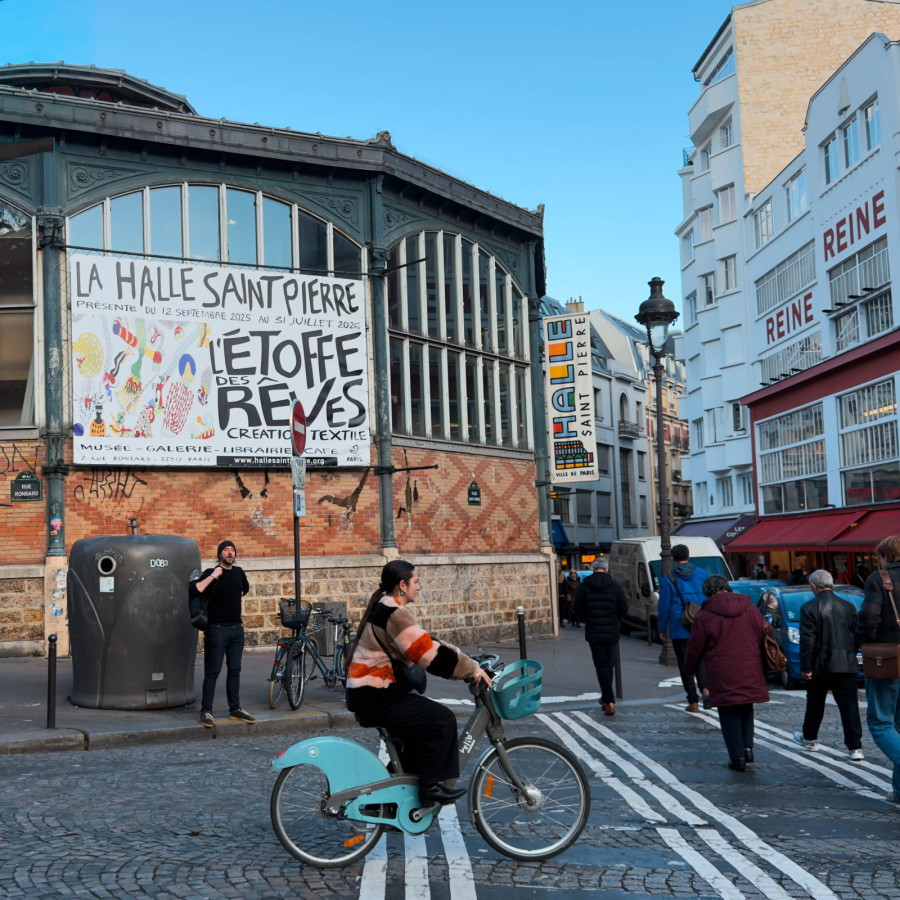
I ended up in Paris rather by accident. I’d flown to Naples and decided to come back by train: Naples to Turin, Turin to Paris, then through the Channel Tunnel to London. Two days in Paris meant I could see several exhibitions, and one of them was at the Halle Saint-Pierre in Montmartre.
I want to mention the space itself before I get to the work. The Halle Saint-Pierre is an outsider art space: folk art, art brut, things that exist outside the main establishment. It sits in the middle of Paris’s textile district about 5 minutes from Montmartre, it is surrounded by shops selling fabrics, yarns, buttons, zips. And the space itself felt genuinely alive. The bookshop was full. The library was full. The café was busy, there were people having head massages, workshops clearly running. It’s the kind of art space we all want more of.
At the moment, right through to the end of July 2026, they have an exhibition called L’Étoffe des rêves (The Stuff of Dreams). Thirty-six textile artists, two floors of work. It’s extraordinary and, honestly, quite overwhelming. I could only take in so much.
So rather than attempt all thirty-six, I want to tell you about three artists whose work stopped me.
Lili Simon
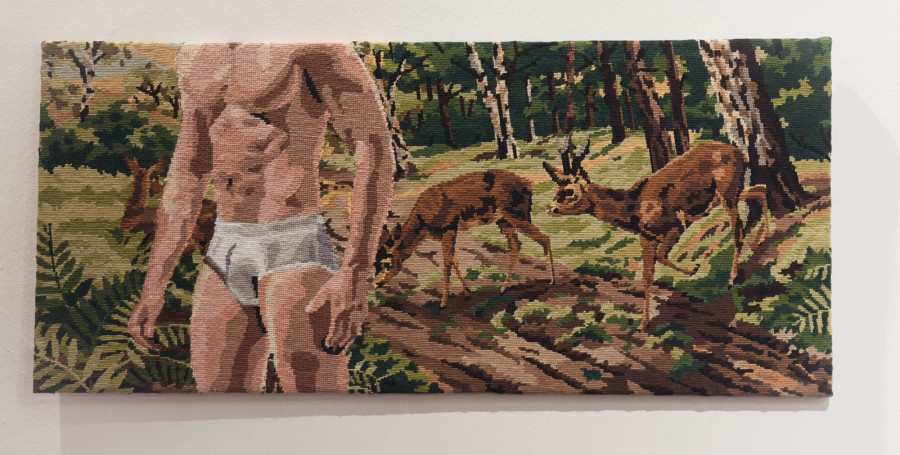
Lili Simon was born in Alsace in 1980. She trained at the Beaux-Arts but her practice has always been more outsider than establishment, taking magazines, catalogues, adverts and subverting them, poking fun at them.
During lockdown, she became interested in needlepoint and started thinking about those very camp, kitsch landscape canvases from the 1960s and 70s. The deer, the mountains, the idealised coastal scenes. Women spending hundreds of hours on these complicated pieces, sitting and thinking. And she started wondering: what are their fantasies? We talk endlessly about the male gaze. But when a woman is sitting stitching for hours and hours, what is she looking at in her mind’s eye?
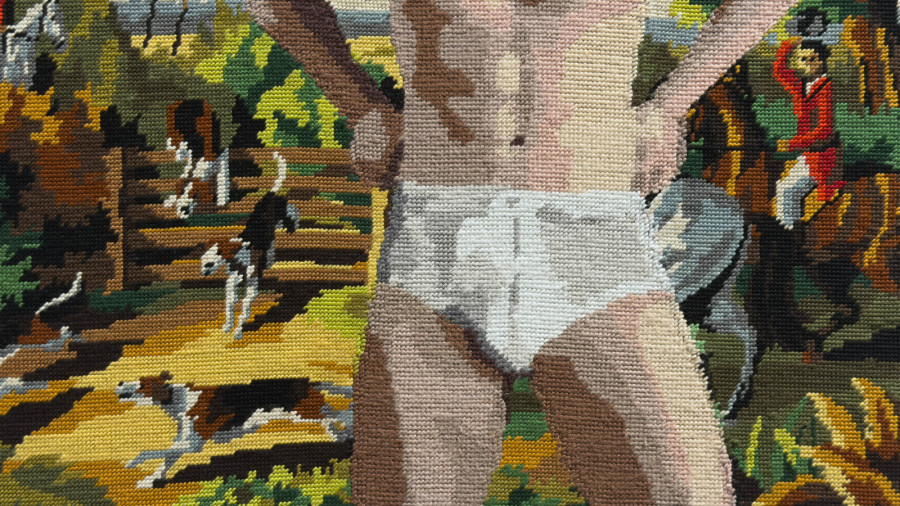
Lili Simon took some adverts featuring men in their underwear (the Calvin Klein kind of aesthetic) and inserted them into the canvases.
She did this in two ways. In some pieces she has carefully unpicked the original stitches and restitched over them to create her figure. In others she has cut the original needlepoint, made a new panel, and sewn it in. Very different techniques, quite different results.
I found them very funny. Understated. And it occurred to me that this is also a genuine technique for craft activism: taking an existing textile object and replacing elements of it with something entirely unexpected.
Aurélia Jaubert
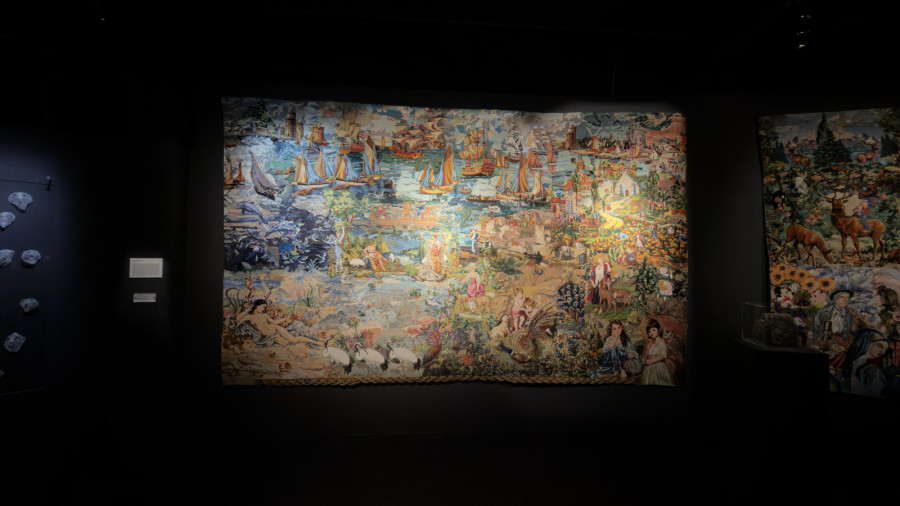
Aurélia Jaubert was born in 1967 and grew up in a household where looking carefully at things mattered. Her mother, Marie-José Jaubert, wrote La Mer assassinée in 1978, a book documenting pollution along the French coastline. Her father, Alain Jaubert, spent his career making documentary films about how to look closely at paintings. That’s the kind of household this is.
She began her big tapestry works in 2017, after years of collecting old needlepoints from car boot sales and flea markets. She has always found them a bit naff, she says, and also beautiful, and also important. Because all of that needlework corresponds to a condition of women. Right up into the 1950s, there were books about how to be a good housewife and how to occupy your leisure time.
Her ambition from the start was to take all of those small domestic pieces and make something monumental from them, something on the scale of a medieval or Renaissance tapestry, with a foreground, a middle ground, a background, figures, and stories.
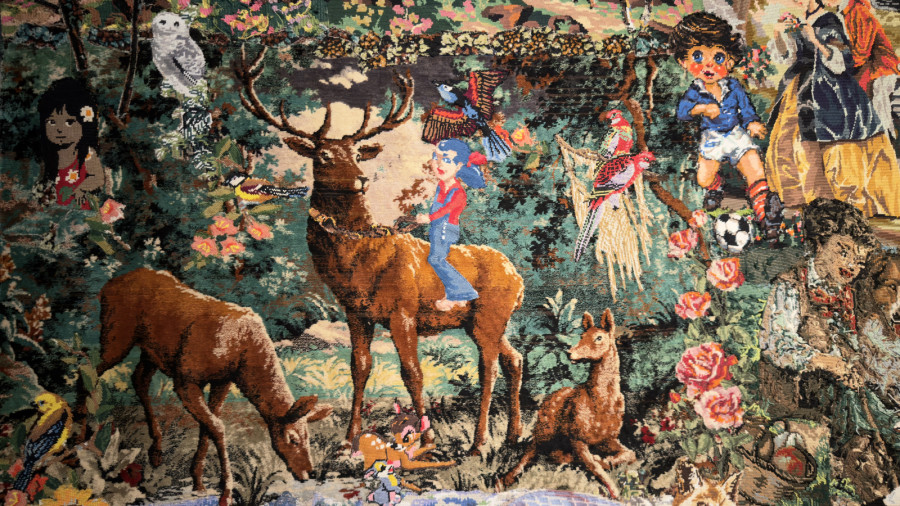
The two works at the Halle Saint-Pierre took up an entire wall. They are extraordinary. There is so much to look at: hunting scenes, women in crinolines, classical figures, animals, all assembled from pieces that might span a hundred years of women’s making. She also uses the backs of some sections deliberately, so you see the workings, something like a pencil sketch showing through, which softens the weight of it all slightly.
People were standing in front of these for a long time.
There is a short film on YouTube of Aurélia working in her studio: cutting needlepoints, assembling pieces, walking round and round the work. It’s worth watching.
Shao Liyu Chen
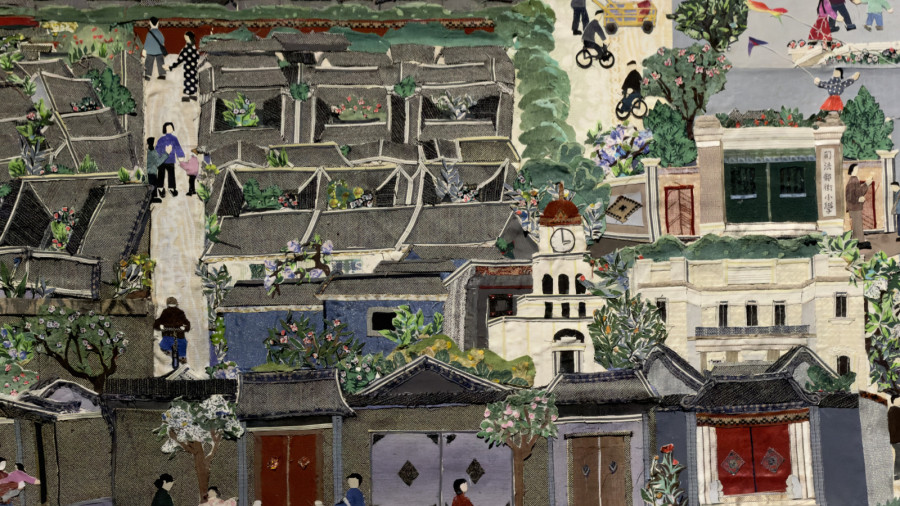
Shao Liyu Chen was born in Beijing in 1946. She grew up in a traditional courtyard house in the heart of old Beijing, in the hutongs, the network of alleyways that ran through the old city. She went to university, became a professor of philosophy, and in the early 1980s her husband left for Paris to study contemporary art. She joined him five years later.
In Paris, she and her husband moved through museums and galleries, absorbing Western art. She began working for a French interiors company, bridging Chinese and Western aesthetics. And then she made a return visit to Beijing and found that the city of her childhood had been largely demolished. Modern towers had replaced the hutongs. The courtyards were gone.
She came back to France and began to make collages. Everything in the exhibition came from her own collection: these pieces were never for sale, never intended for galleries. They are made from tiny scraps of fabric, assembled into dense, teeming cityscapes and landscapes of a Beijing that no longer exists.
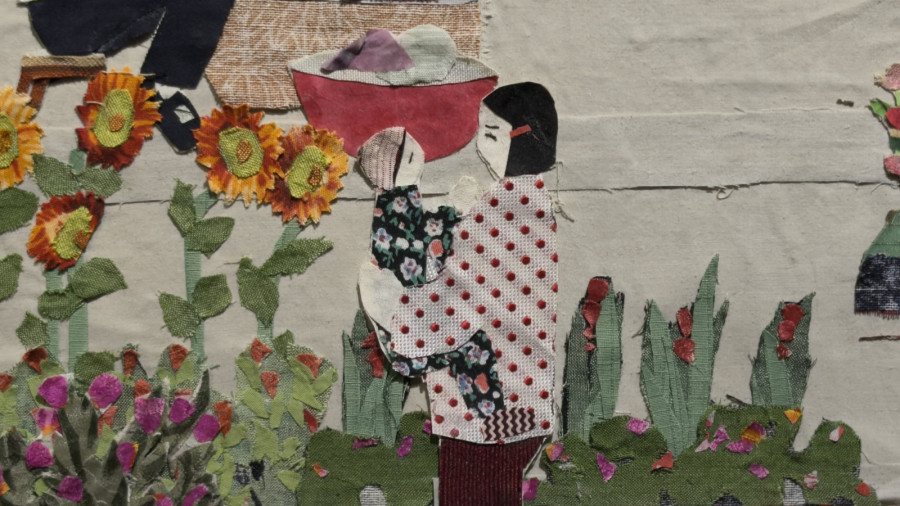
The level of detail is remarkable. People stood in front of these for a long time too, finding things: a bicycle, a fire, a dog, a cart. Made from the smallest fragments of cloth.
She is nearly eighty. She came to this work in her forties, after a career in philosophy and cultural work. Everything in the exhibition belongs to her personally. That felt significant.
Why these three
These are by no means the only artists worth seeing in this exhibition. But they are the three that connected most directly to conversations I find happening all the time in The Studio: about repurposed work, about the labour of women, about memory, about what we do with the small scraps of things we accumulate and don’t quite know what to do with.
If you have old needlepoints piling up. If you have a bag of tiny fabric scraps. If you’re wondering what those things are actually for, this exhibition has something to say about that.
The Halle Saint-Pierre, 2 rue Ronsard, Paris 18th. L’Étoffe des rêves runs until 31 July 2026. Open Monday–Friday 11am–6pm, Saturday 11am–7pm, Sunday 12pm–6pm.
Vintage linens in Naples
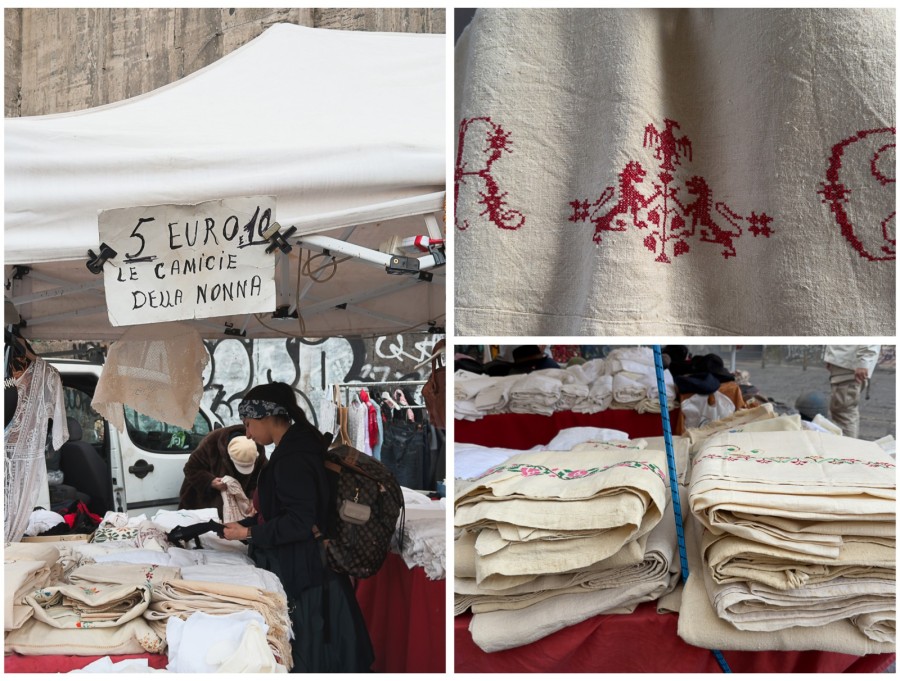
Two years ago I stumbled across a market stall tucked into a side street behind Via Toledo in Naples. It was piled high with household linens - table cloths, napkins, pillowcases - all from somebody’s nonna. I bought some heavy linen or hemp napkins and cursed my hand luggage suitcase the whole way home.
Last year I went looking for it. Walked round and round, asked people, found nothing. I assumed it had been a one-off.
This morning I was heading back from the bookshops (I’d been picking up books for the next Studio project, Almanac) and instead of turning right along the music shop street, I went straight on. Past some bins, past a car park. And there it was.
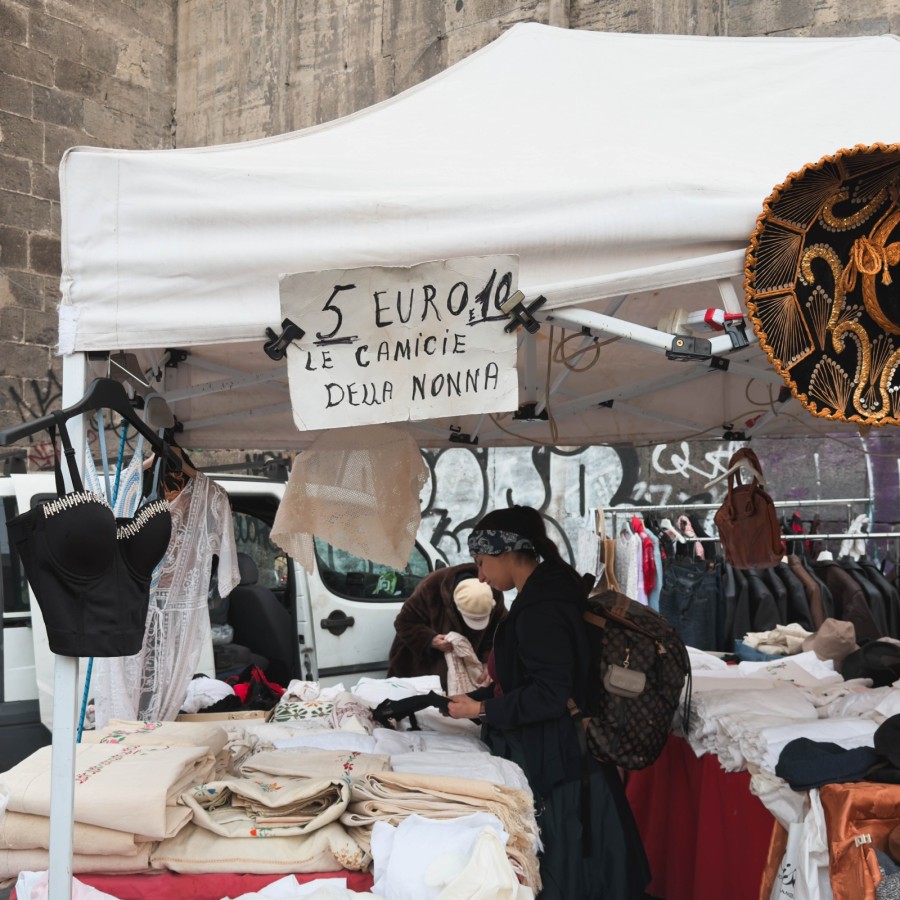
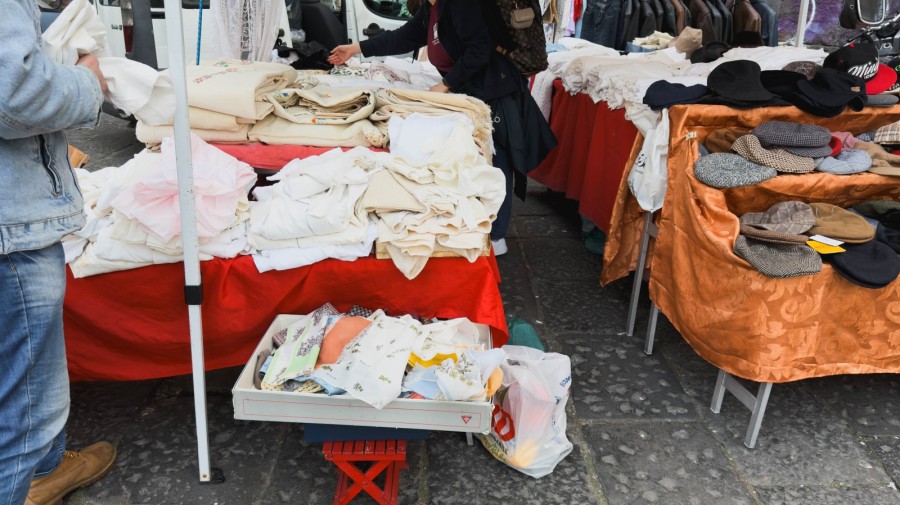
Not quite as piled up as before, but the same stall, the same linens. Table cloths, hand towels, pillowcases, all with matching initials. A family’s dowry, sold off piece by piece.
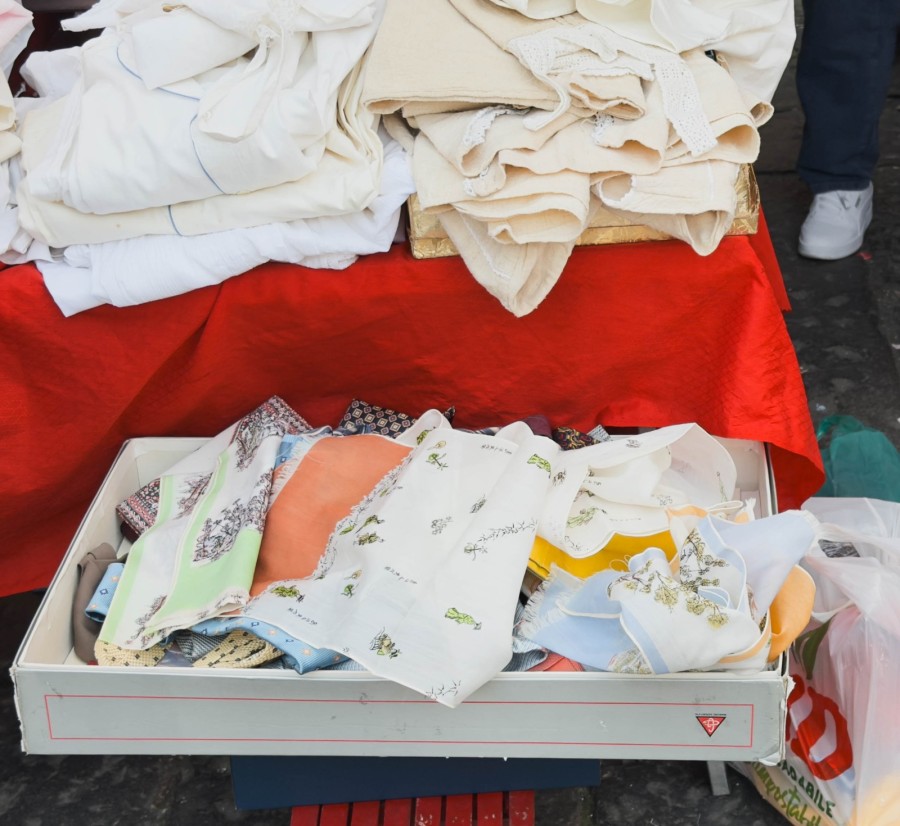
I bought two things: a heavy linen bedspread with an elaborate red cross stitch monogram, three hand loomed strips seamed together with hand stitching (though the hems are machine stitched), and a hand-woven shift that I’d put at late 19th century, possibly very early 20th. Twenty-five euros for both. I left everything else and walked away quickly before I could regret it.
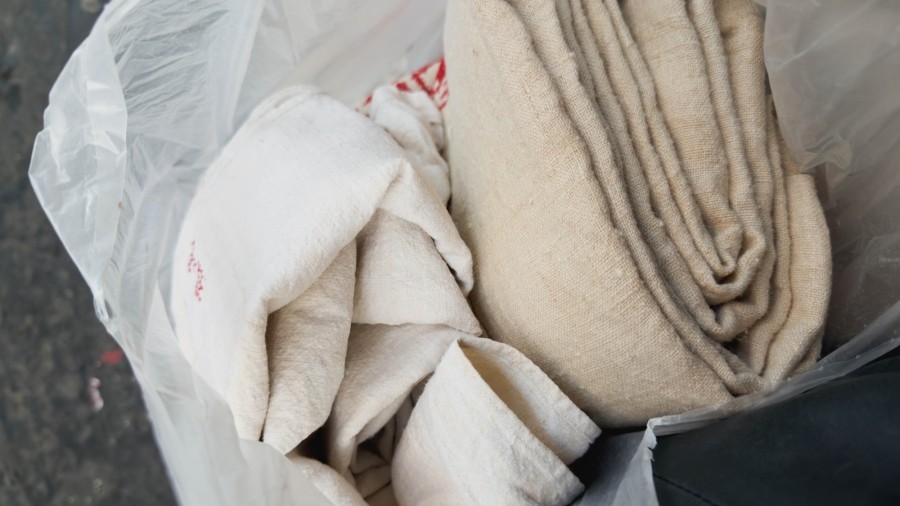
If you find yourself in Naples and want to try your luck: go along the Via Toledo to Piazza Dante, up the Via Port’Alba through the bookshops, then straight on towards Piazza Luigi Miraglia. The stall, when it’s there, is on the right. I’ve found her twice by accident on a Tuesday - I can’t tell you more than that.
Ancient cordage and a mummified crocodile
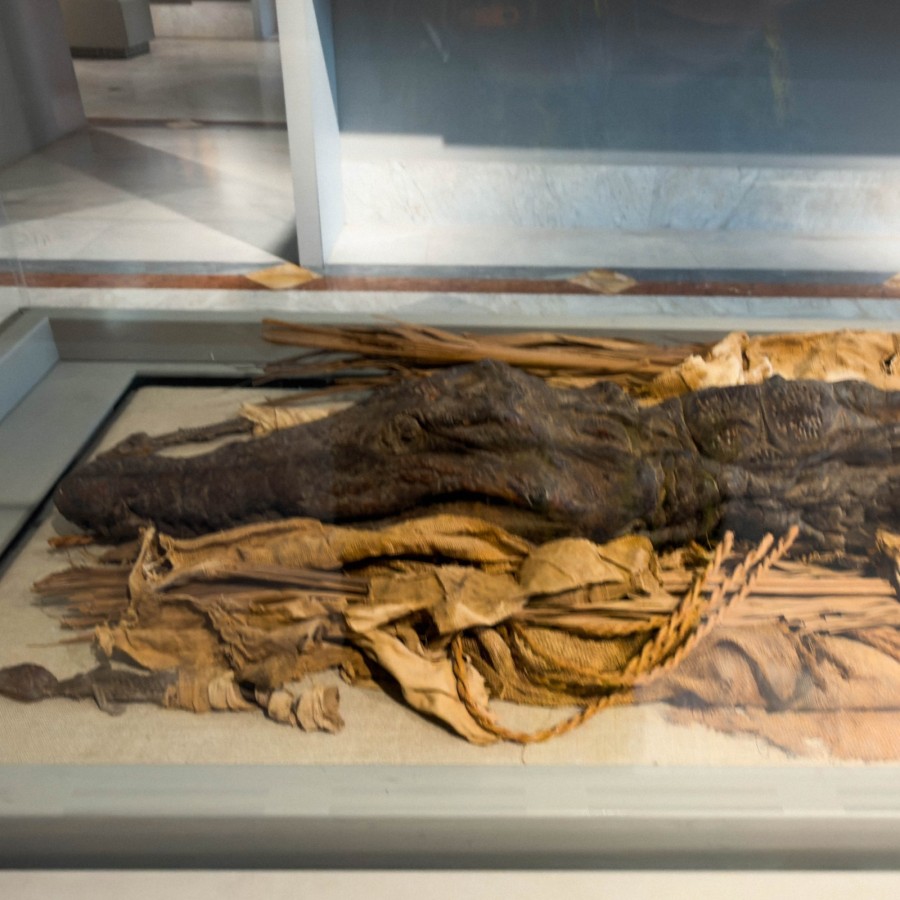
I promised in a Studio Bee that I would go back to MANN, the archaeological museum in Naples, and take some photos of the mummified crocodile there — to show you how the string used to bind its wrappings is exactly the same at heart as the string we made in Threaded at the end of last year.
Cordage rarely survives. It’s organic material and it rots. What we usually find at archaeological sites is an impression in clay or a stain in soil. To see the actual thing, still holding its twist after two thousand years, is unusual. This crocodile dates from 664-332 BCE.
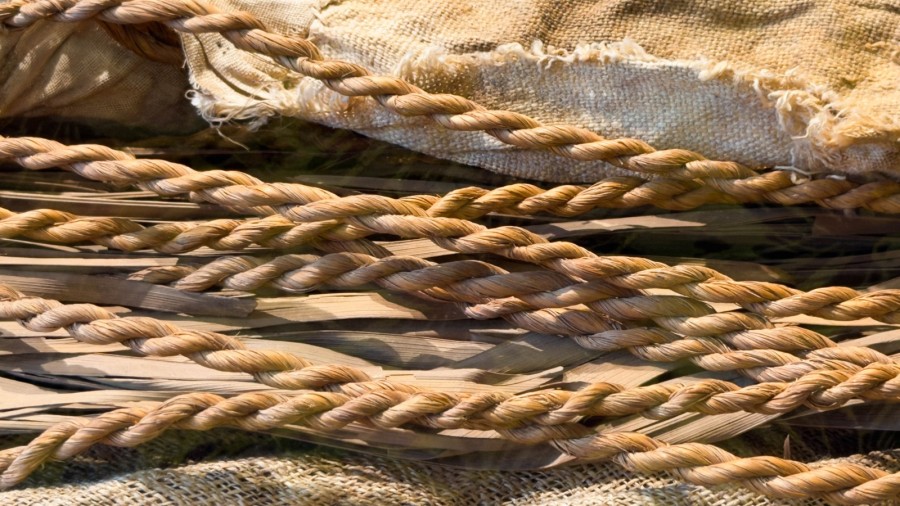
These crocodiles were offerings to Sobek, the crocodile god - present in the Egyptian pantheon from the Old Kingdom right through to the Roman period. He was seen as the creator of the Nile, a god of fertility and water, believed to have risen from the primordial dark to bring order to the world. His nature was deliberately double: dangerous and protective at once. The crocodile was feared and revered for exactly the same reasons. Live, jewellery bedecked, crocodiles were kept in some temples.
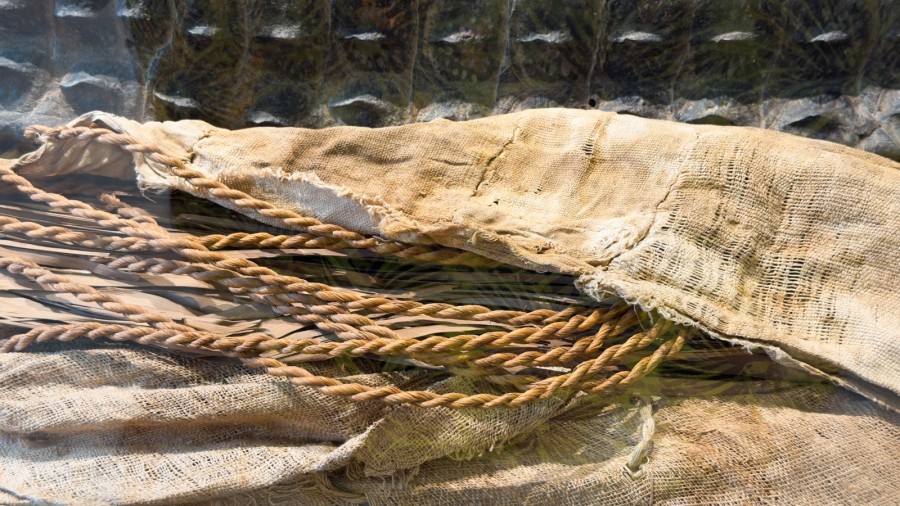
Crocodile priests wrapped these animals with the same care used for human mummies. The wrapping was ritual work - linen, palm leaves, and rope, wound carefully around the body. In this particular mummified crocodile there are six different kinds of weave in the bandages and two baby crocodiles included as symbols of fecundity.
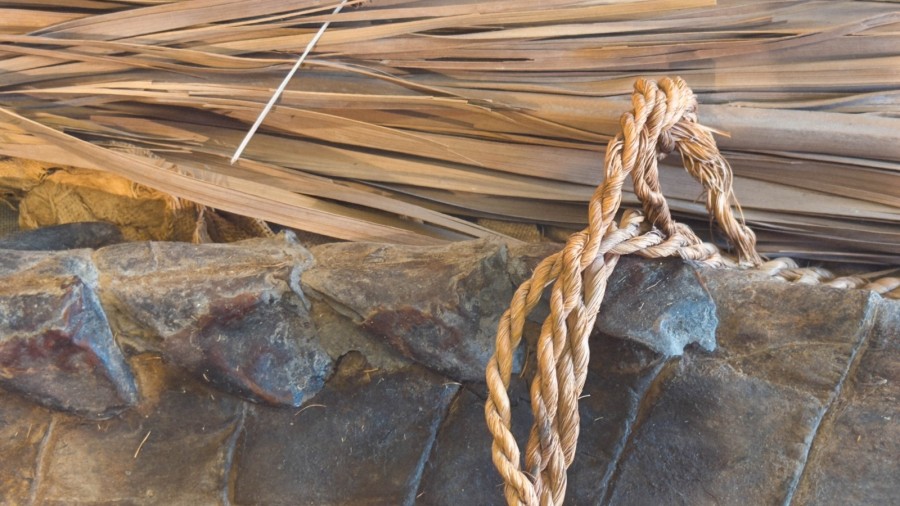
In some cases the cordage had served an earlier purpose too: gruesomely, some mummies show evidence that the crocodiles were tied and left in the sun to die before being prepared for burial.
The Colours of Naples Fishing Nets
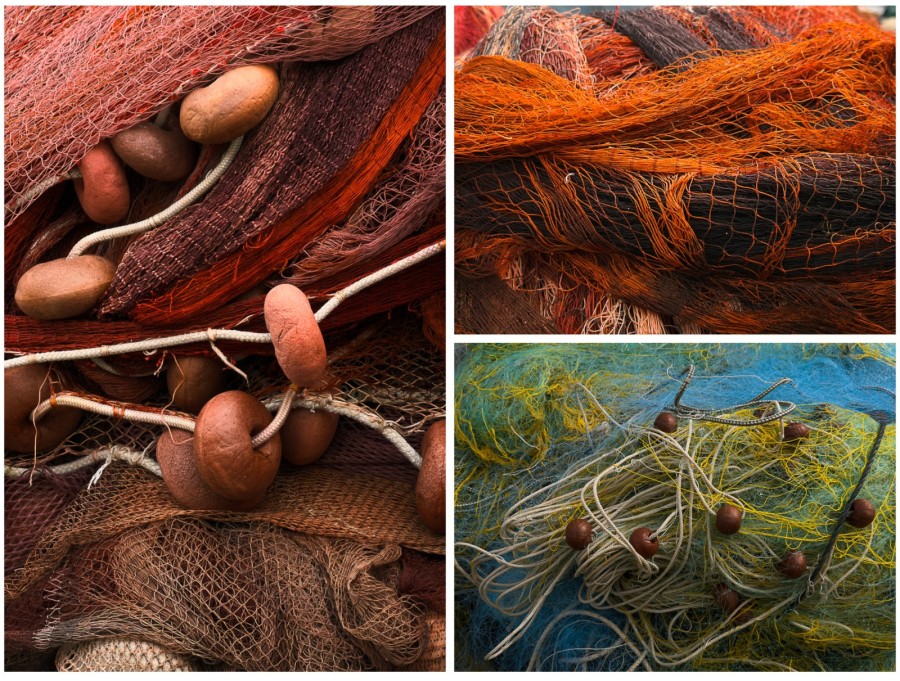
The flat I stay in in Naples is about a three-minute walk from the sea. Most days I walk right along the promenade from the shops at one end, past the ice cream shops and the disused park, all the way to where the fishermen land their catches.
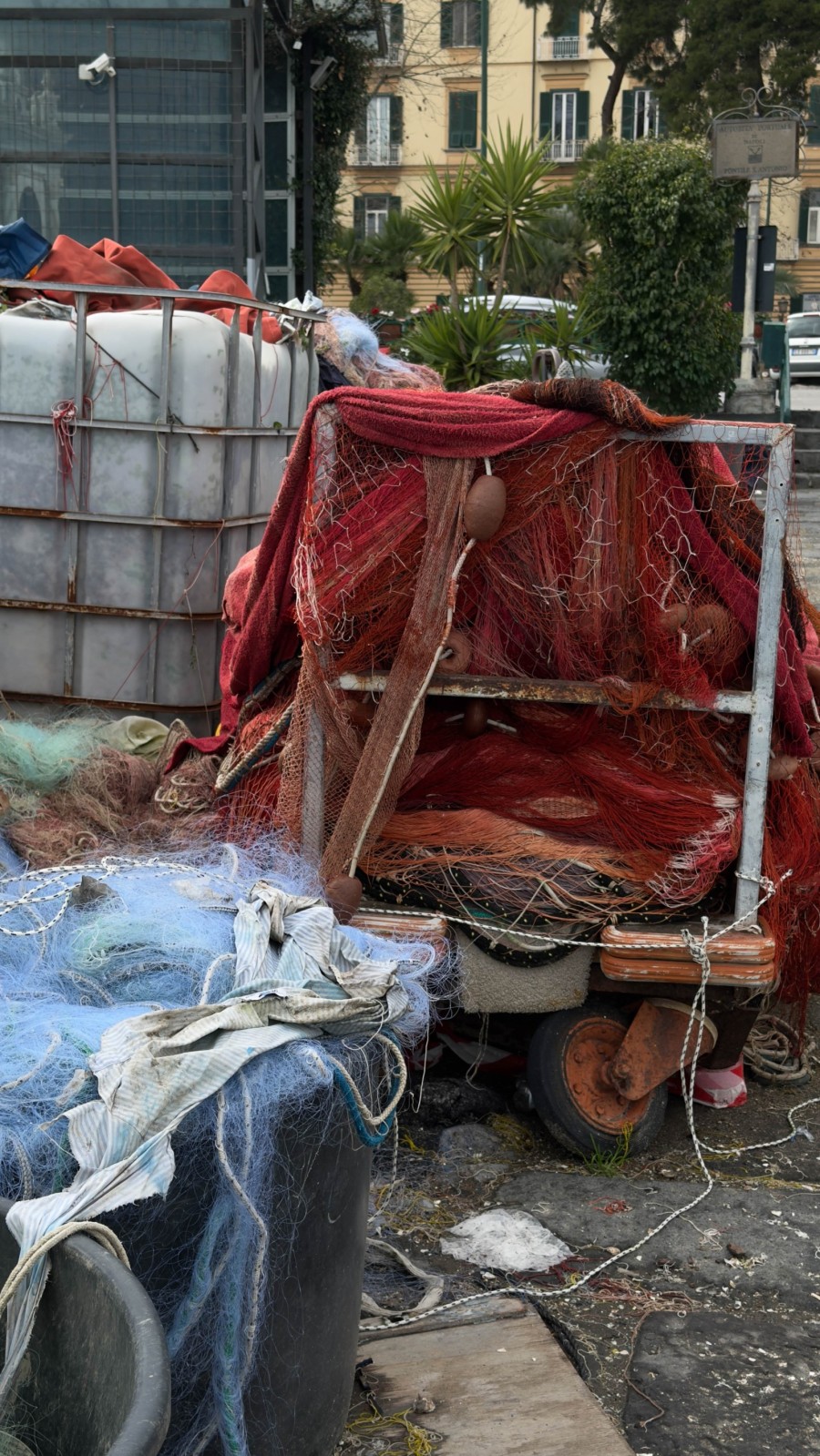
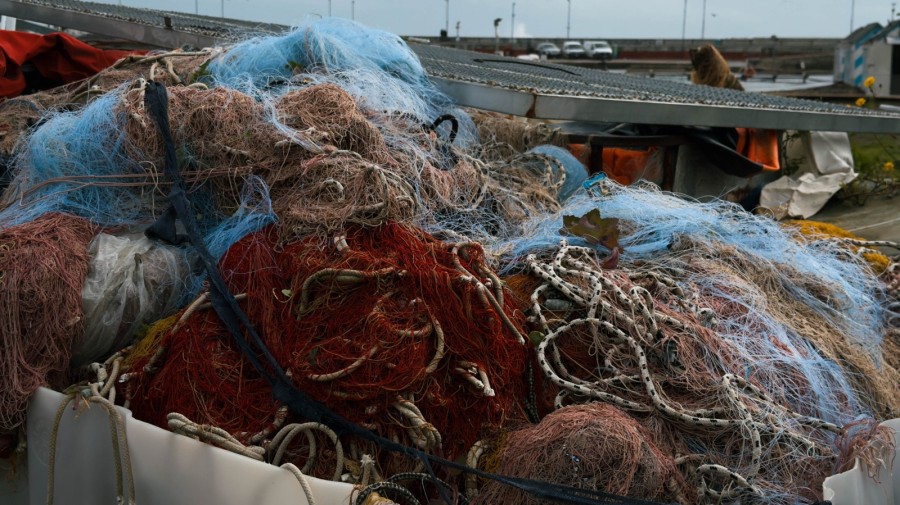
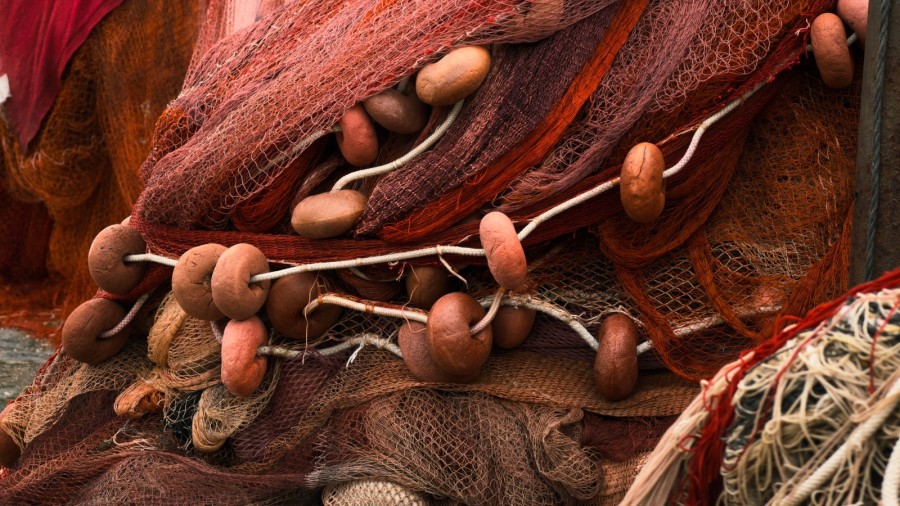
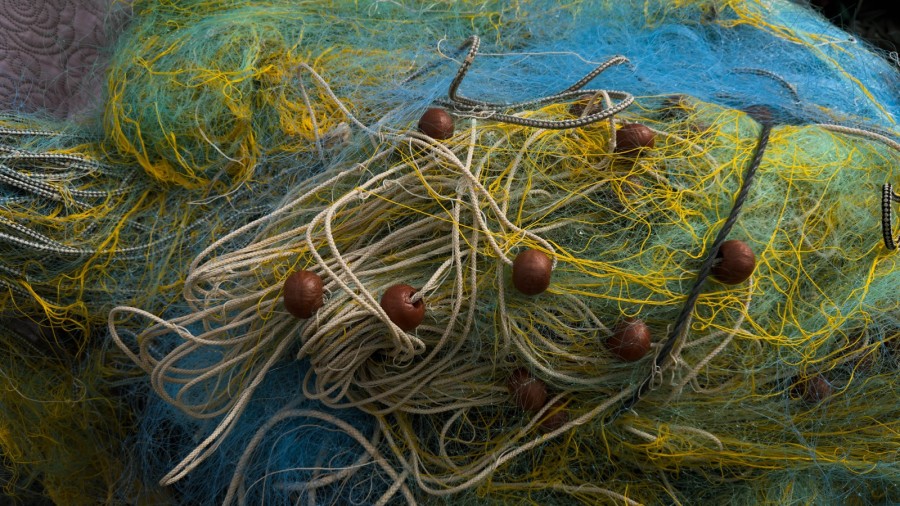
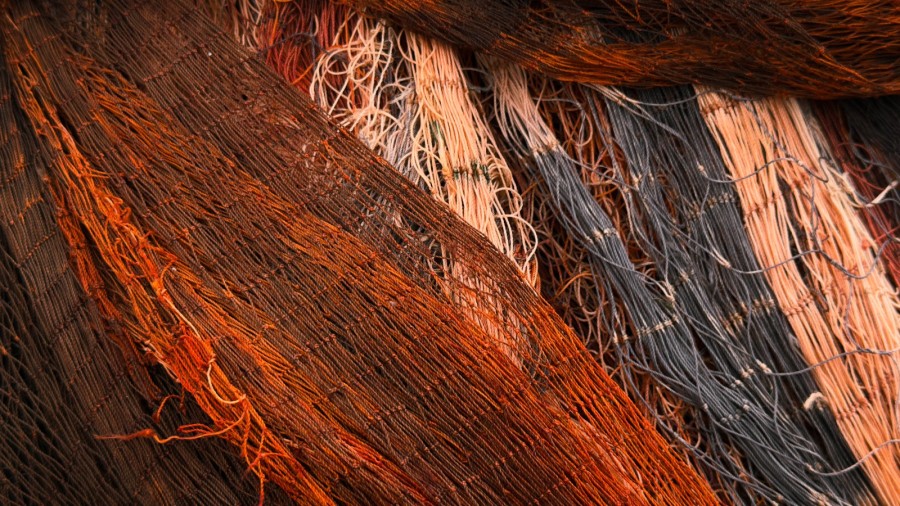
It has been so stormy here lately. Nets have been piled up into big bins, discarded, tangled together. I walked past them on the way out and didn’t think much of it. But on the way back, I stopped.
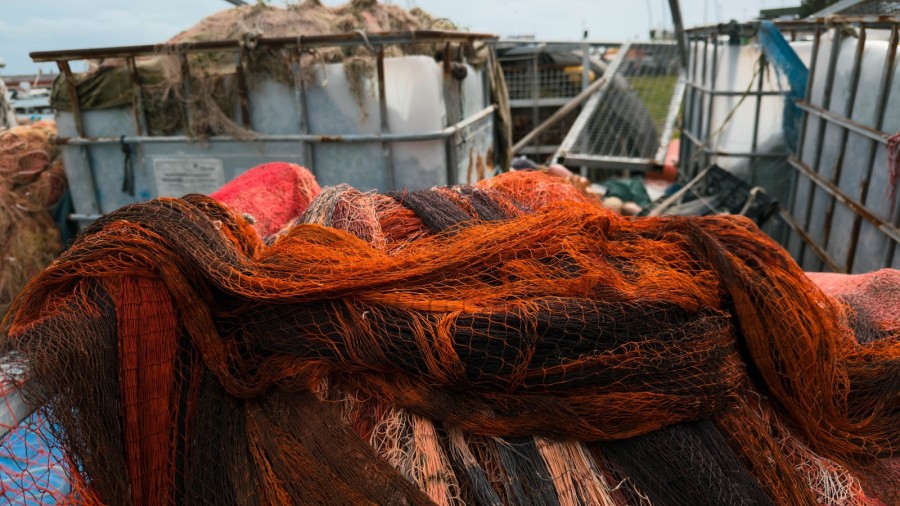
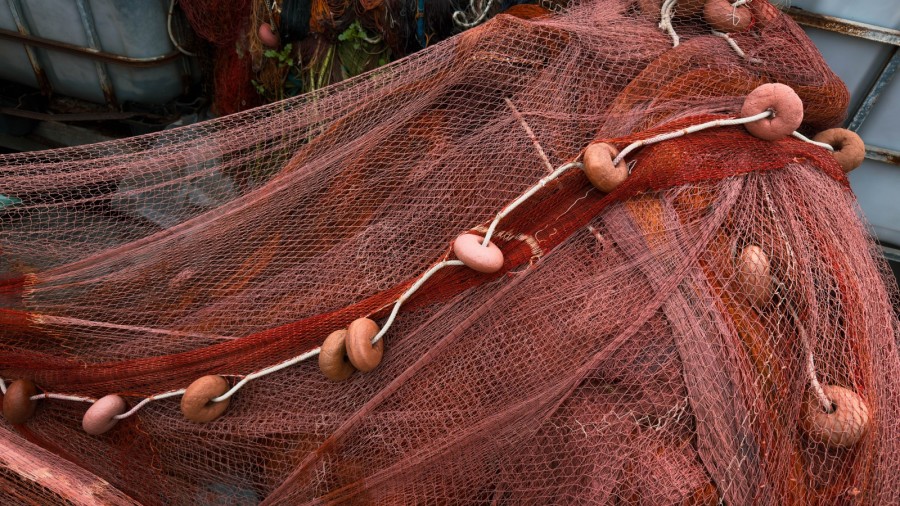
Layers of red and rust and deep orange tangled up with turquoise and yellow, all faded and salt-stained. I took out my phone and snapped these images.
Working materials age in ways you can’t design on purpose. The sun and the salt have done their own slow altering of hue.
Every net is a different weight, a different mesh, a different stage of wear. The rust coloured floats sit in the folds like worry beads. The whole thing looked more like a textile installation than a working harbour.
I have no particular plan, no project in mind. Just colour and texture worth paying attention to.
 RSS
RSS