Journal
The Indigo Jacket: A Morris Work Garment Given a Second Life
Earlier this week I had a day in London. The main reason for going was V&A East Storehouse in Hackney Wick, which is the behind-the-scenes home of so much of what you see at the V&A in South Kensington.
It shows you the work that goes on long before anything reaches a display case: making mannequins for the fashion exhibitions, conservation, storage, all the planning that happens months and years ahead. I found it absolutely fascinating. If you’re in London, do go.
Ordering an object
What I was really there for is a service tucked inside the Storehouse called Order an Object. You browse the online catalogue, and if something is marked as available to order, you add it to your list and book a time. When you arrive, your objects are laid out on a table and you can spend time with them on your own.
Book several weeks ahead if you can, because space is limited. And if you live in London, or are passing through, put it on your list.
Part of the joy is glancing at other people’s tables. On one there were seventeenth-century architectural drawings, on another an Elizabethan embroidered baby’s bonnet, and on a third a collection of Care Bears. There really is everything.
Why I was there
I’d gone mainly to look at crazy patchwork. In The Studio we’re working on crazy patchwork at the moment and linking it back to the 1880s and 1890s when it was at its height, and the V&A has two wonderful examples you can order.
You can order up to five things, though. So I filled my other slots with objects that had caught my eye in the catalogue, and one of them was this jacket.
What the catalogue says
The V&A’s record connects the jacket to Georgiana Burne-Jones and William Morris. The story, which came to the museum through the Burne-Jones family when it was given in 1979, is that Georgie made it for Morris. The museum dates it to around 1875.
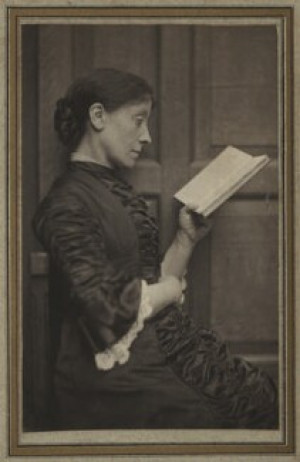
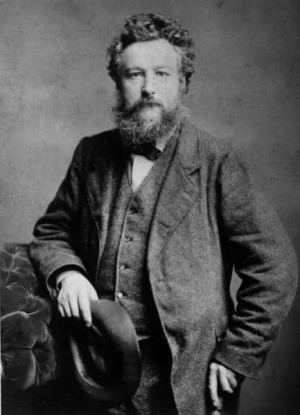
Georgie and Morris were lifelong friends. They were part of that early circle around Red House, the house Morris built when he married, and for a while there was an idea that the Burne-Joneses might live there too, in a more communal kind of household. So the story makes sense.
What drew me to it was how personal it is. In museums you’re mostly looking at things made by professionals, and much of the Morris & Co. work I’ve seen was made for the firm and for its customers. A jacket embroidered by a friend is something else. I love the personal.
A jacket you could wear today
The first thing that struck me, sitting with it, was how wearable it is. If I could have slipped it out of the museum and worn it home, I would have.
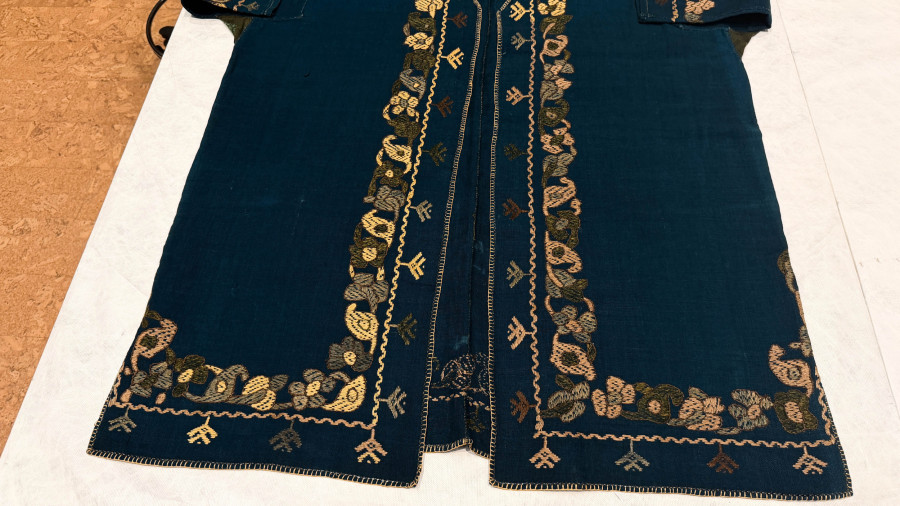
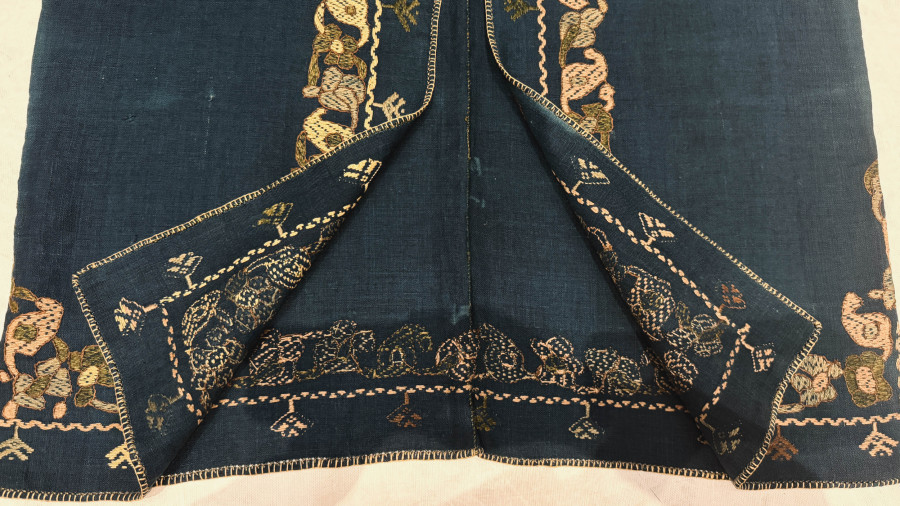
It’s made of indigo-dyed linen and built almost entirely from rectangles. There are two panels for the front, two for the back, and the sleeves are rectangles set into those. The seams are all hand-sewn. It’s very, very simple.
Then every edge has been embroidered. And the longer I looked, the more I thought the real story here is more interesting than “Morris designs a jacket and his friend makes it for him”. There are things about the underlying jacket that suggest it existed for some time before the embroidery was added.
Morris and the indigo years
1875, the date the V&A gives, is right in the middle of Morris’s obsession with indigo.
We tend to think of Morris through those swirling printed florals, and that is one side of the work. But at the heart of it was a man who was hyper-focused, impatient and endlessly curious. He didn’t want to give orders for something to be made unless he knew exactly how to make it himself.
From 1875 he was spending long stretches at Thomas Wardle’s dyeworks in Leek, and keeping an indigo vat at his workshop in Queen Square in London, trying to get indigo to do what he wanted for printing. His letters are full of blue arms and blue hands. In one, to his daughter Jenny, he has to go and scrub them so he’ll be let into the theatre.
He described himself working in the dyehouse in clogs and a workman’s blouse, and plain indigo work clothes were part of how he dressed through those years. I think this jacket comes from exactly that time. It was a working garment first.
Why I think the jacket came first
The jacket is worn, the embroidery isn’t
The jacket has clearly been worn a great deal. It’s been put on over and over, it’s been repaired at the armholes, and it was obviously a loved piece of clothing.
The embroidery, though, isn’t worn at all. For something that age it’s almost pristine.
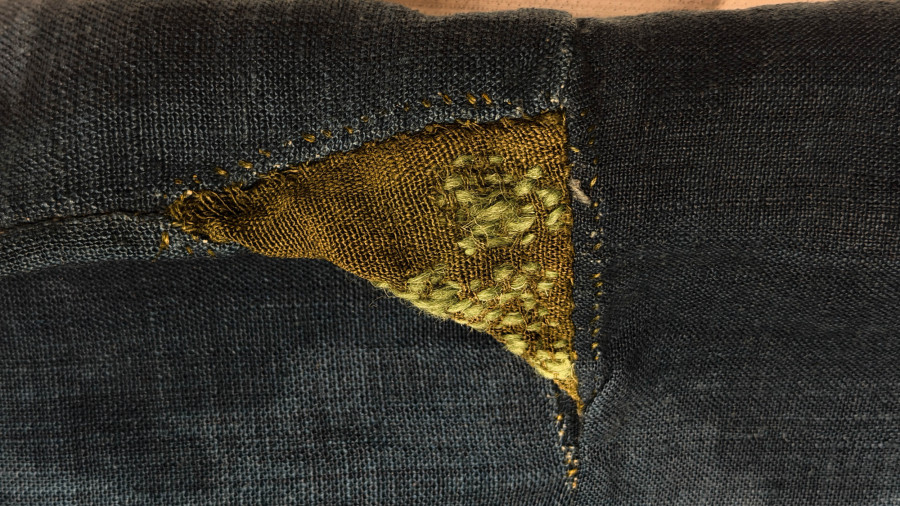
There’s no blue on the threads
If you embroider onto newly dyed indigo, it’s almost impossible to stop some of the colour rubbing off onto your threads. The loose particles get caught in the texture of the wool.
There’s no transfer of blue onto these threads at all. That suggests the indigo dyeing was done well before the embroidery, and that the cloth had been washed again and again until it stopped shedding.
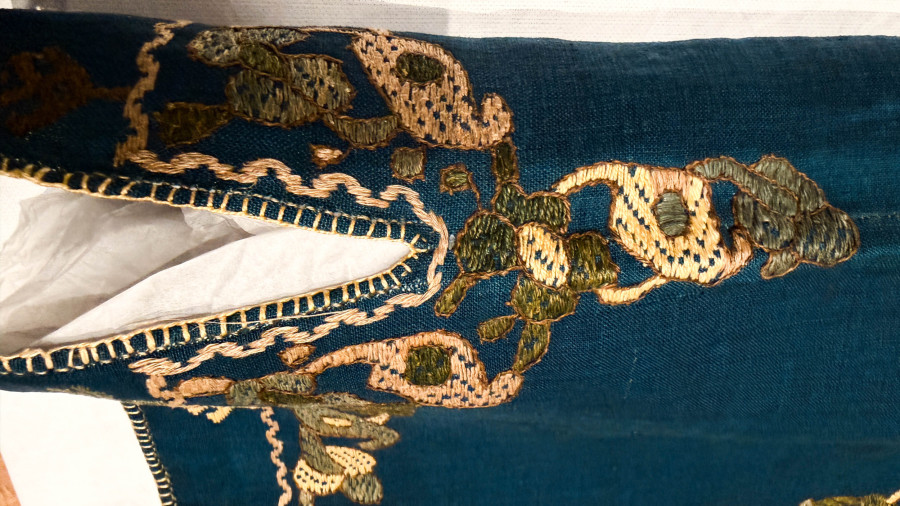
The colours haven’t faded
There’s very little difference in colour between the embroidery on the inside and the outside of the jacket. Plant-dyed wools fade where the light hits them, so this tells me the embroidered jacket hasn’t spent much time out in the sun.
Put together, I think Morris wore this jacket through the 1870s, and then at some point, possibly not long after, it was embroidered. Whether that was Morris’s suggestion or Georgie’s, I don’t know.
The original making and the embroidery
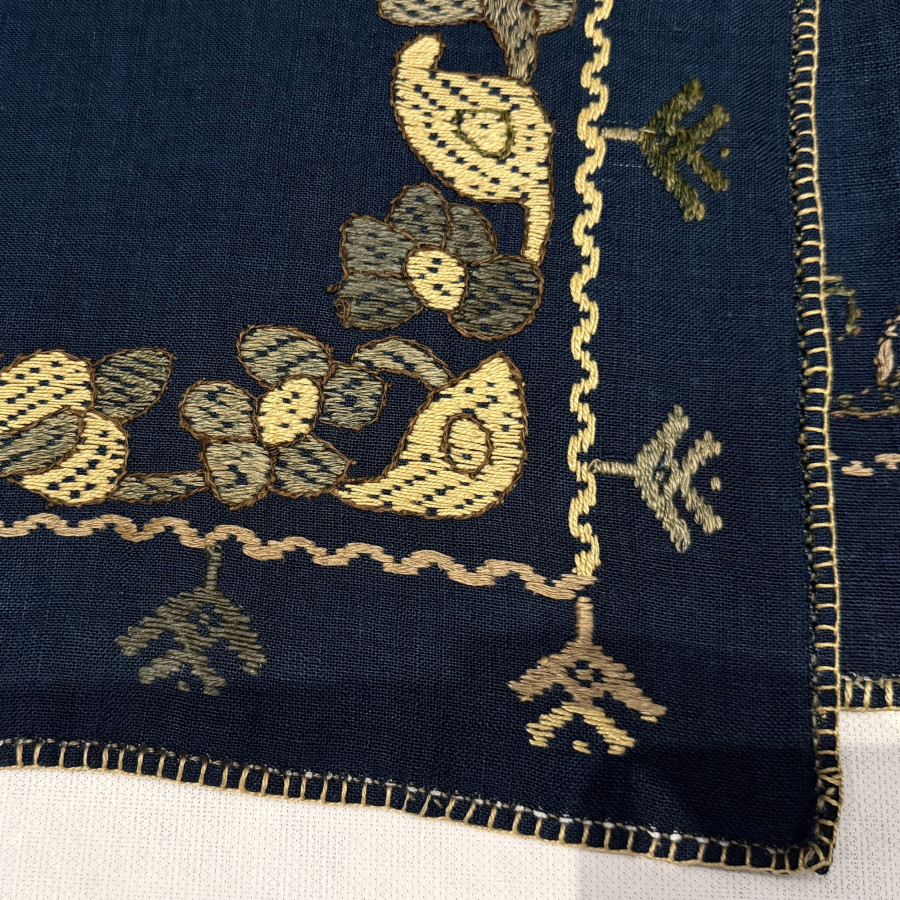
The original jacket was finished very conventionally, with neatly rolled hems and hand-stitched seams. The hems have been worked so that the thread loops round at the bottom, drawing four or five threads together and leaving a tiny hole before the next stitch. It’s a neat, deliberate finish that was used on table linen and underclothes at the time.
All of that has been covered by the embroidery. The edges are worked over in quite large buttonhole stitch.
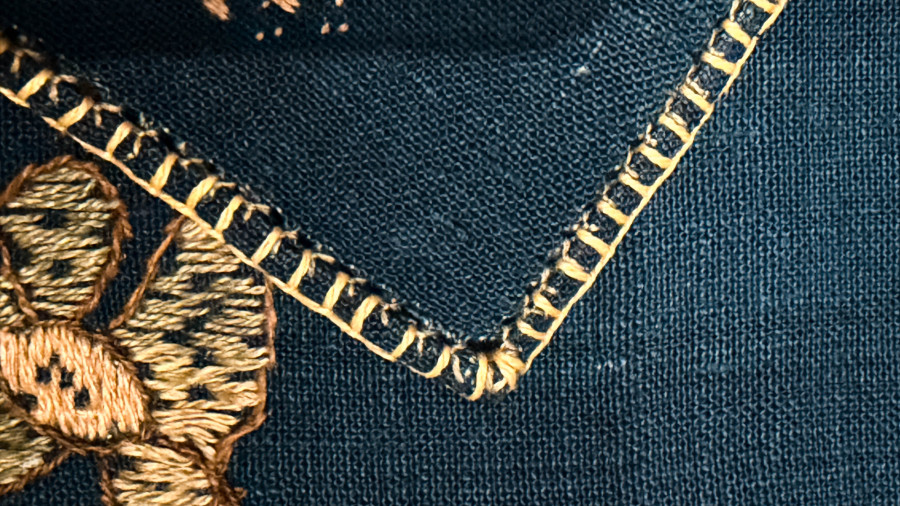
The design itself is simple, but it must have been laid out very carefully, because it has to fit the garment and it isn’t quite symmetrical. It’s worked in counted threads: parallel stitches in wool, each one counted on the weave of the linen. Some of the shapes are then outlined in stem stitch.
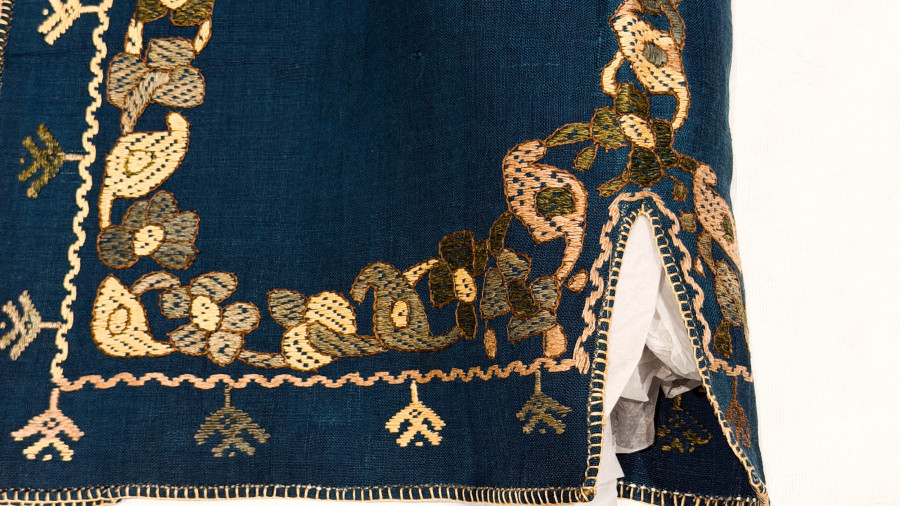
The wools are all plant-dyed, and they must have been dyed in fairly small batches. Partway round, the colours shift slightly. It isn’t a design choice. A vanilla colour and a cream colour have been used, and it looks as though one ran out and the work carried on with the other. There’s no way of telling which was the first choice.
A makeover, not a making
So I came away believing this isn’t a jacket made from new. I think it’s a much-loved piece of clothing that was revamped, given a makeover and brought back into use.
And that feels very much of our time.
It made me realise I could make a jacket like this. The construction is so simple, and I do like hand-sewn seams. But equally, I could take a piece of clothing I already love, one that fits me and has had a life, that’s maybe beginning to wear under the arms or just looking a bit tired, and use this as a starting point for bringing it back.
What would you choose from your own wardrobe to give a new life like this?
You may also enjoy …
Natural Dyeing with Buddleia: How to Get a Rich Gold from Garden Weeds
Buddleia gives a warm old-gold yellow on pre-mordanted wool and it costs nothing to collect. Here's the whole process, from spent flowers to finished skein.
7 months ago
Growing and Drying Calendula
growing and drying calendula flowers for herbal balms
5 years ago
Decorating squash for Autumn and Halloween
decorating a pumpkin with pen and ink
8 years ago
"Birch leaves in a bottle" embroidery part two
embroidered and appliqué picture of birch leaves in a bottle by Jane Lindsey of Snapdragon Life
3 years ago
 RSS
