Register
My basket£0.00

Journal

Comparison is the Thief of Joy (and Creativity)
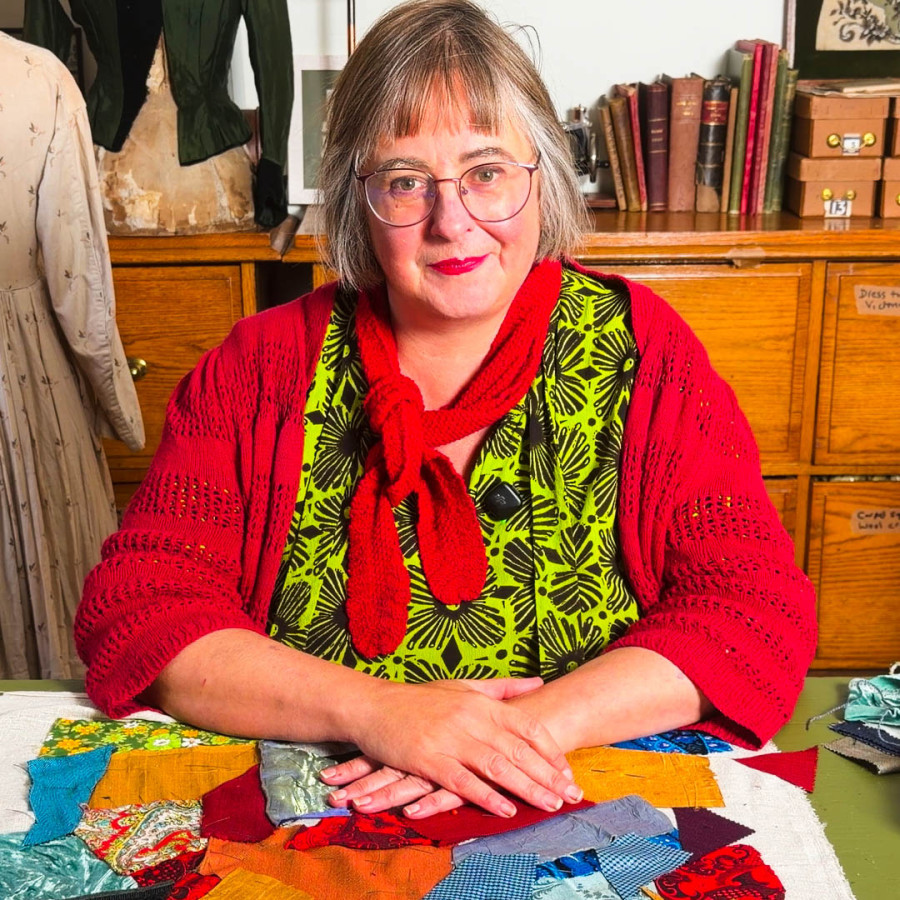
I had always assumed “comparison is the thief of joy” was a proper quote from someone. When I looked into it, it turned out to be much newer than I thought. The exact phrase first turns up in print in 2004, credited to nobody. It only became attached to Theodore Roosevelt around 2012, when inspirational quotes were everywhere on Pinterest and Instagram, and later to Mark Twain too. Neither of them said it.

I find that quite telling. We seem to have invented the saying at exactly the point we needed it most. Filters, editing apps and now AI mean what we see on our phones is further from reality than ever.

This week’s Friday Film is about where comparison gets into making. I see it in three places.

At the start of a project

Earlier this year I wanted to embroider the bodice of a dress for my maker’s wardrobe. I made a Pinterest board for inspiration, pinned happily for a while, then looked at what I’d collected. Most of it was 17th-century court dress and haute couture. Work made by teams of professional embroiderers who had trained for decades.

Instead of inspiration, I’d built a gap between that and what I could do. I abandoned the project.

Five well-chosen examples, ideally printed or from a library book, would have served me far better. Things to learn from as part of my own process, rather than a wall to measure myself against.

In the middle

Make-alongs, the seasonal projects in The Studio, the rush when a popular designer releases a new pattern. These are lovely, but they also make the fastest makers very visible.

People work at different speeds for all sorts of reasons. (The only time I finish knitting quickly is when I’m unwell and stuck in bed.) When I used to send out craft boxes, some people finished within the week, some took a couple of months, and some opened their stocking kit two years later and made it then. All of that was fine.

What helps is saying where you actually are. “I’ve downloaded the pattern”. “I’ve got the fabric out of the cupboard”. That keeps you part of the project, and it shows everyone else that not everyone is racing ahead.

At the end

You finish something and look at it on the breakfast table, among the dishes, in poor light. Then you look at photos online that have been styled, lit, edited and possibly run through AI. Grass isn’t even green online any more, it has become an aesthetic, moody olive.

Knowing all that doesn’t stop it affecting how we see our own slipped stitch or the untidy back of our embroidery.

This is one of the reasons I love working with original pieces. You can see the mistakes, the shortcuts, the patches, and the moments where someone clearly decided it was only a pair of socks. It connects you to the maker, and it reminds you that the making is the point.

So make with your hands. The less you scroll, the less room comparison has.


Comments: 5 (Add)

You must be signed in to post a comment. If you're already a member, please sign in now. If not, you can create an account here.
Betsy Miller

Thank you, Jane, for another well-thought out message. I was a quilting teacher for years and I used to tell my students that not every project needed to be finished-sacrilege-and done is better than perfect. The joy of doing and learning is what making is all about, in my opinion, although out latest technology refutes that.

Lynne Nicoletti

Thanks, Jane, for this incredible observation.
I never gave much, if any, thought to how intense, dishonest and pointless comparison was sapping my enjoyment of so many aspects of life. As you said, modern devices and AI have pushed this pressure into the realm of the absurd.
Thinking about it now, it seems possible that the comparison trap could have started with good (though deeply misguided) intentions.
At first, in an attempt to get us to behave better, we’re compared to other young relatives and children who sport halos and wings and never get into trouble. Later, at primary school, our teachers hold up examples of class work that illustrate both wonderful and shameful results (I suppose this was intended to spur the ‘failures’ on to better performance). Thus, from a very early age, we’re taught to use comparison as a tool to better ourselves. We go on to accept and use/misuse/overuse this tool throughout our lives.
Unfortunately, over time, for those who were never held up as glowing examples of anything, it can become a major, destructive element of self-image.
Even those who were always on the other end of this ridiculous practice would, eventually, come across others who were ‘better’… and wouldn’t know what hit them.

Joelle Harris

I was only thinking about this earlier in the week. I was remembering how in the early 90s as a new parent, living in a small village where I knew no one, I put a card in the shop offering dressmaking, repairs and alterations. One of the jobs I got was sewing name labels into school uniform (someone off to private school) and I had to embroider initials onto PE kit. I'm sure I just got on with it, maybe consulted my sewing book. Now I would have to scroll Pinterest and find all the beautiful samples, and find my skills lacking, and lots of self doubt.
I no longer have FB or Instagram, seriously considering ditching Pinterest too!

Louise White

Jane, What a wonderful message about comparison and thief of joy. I think listening to a person who has made something is just as important as what they have made. The creating as you said is the joy. I think perfection is way over rated. Even if I never learn to knit, I enjoy hearing how something
Is created . The process is so much the intriguing part of how and why something has been created. Thank you Jane. Louise

Linda Fabian

Thank you, Jane, for this gift, that, I'm sure, will keep on giving each time I watch it. It was freeing, validating, and I could think of many stalled projects during. Especially timely with the current "crazy" project on my table. Back to work.

Loading

This site may set cookies for essential tasks, such as tracking whether you are signed in.

We would also like to set analytics cookies to better understand our users’ behaviour.