Journal
Red Lipstick Myths: What the History Actually Says
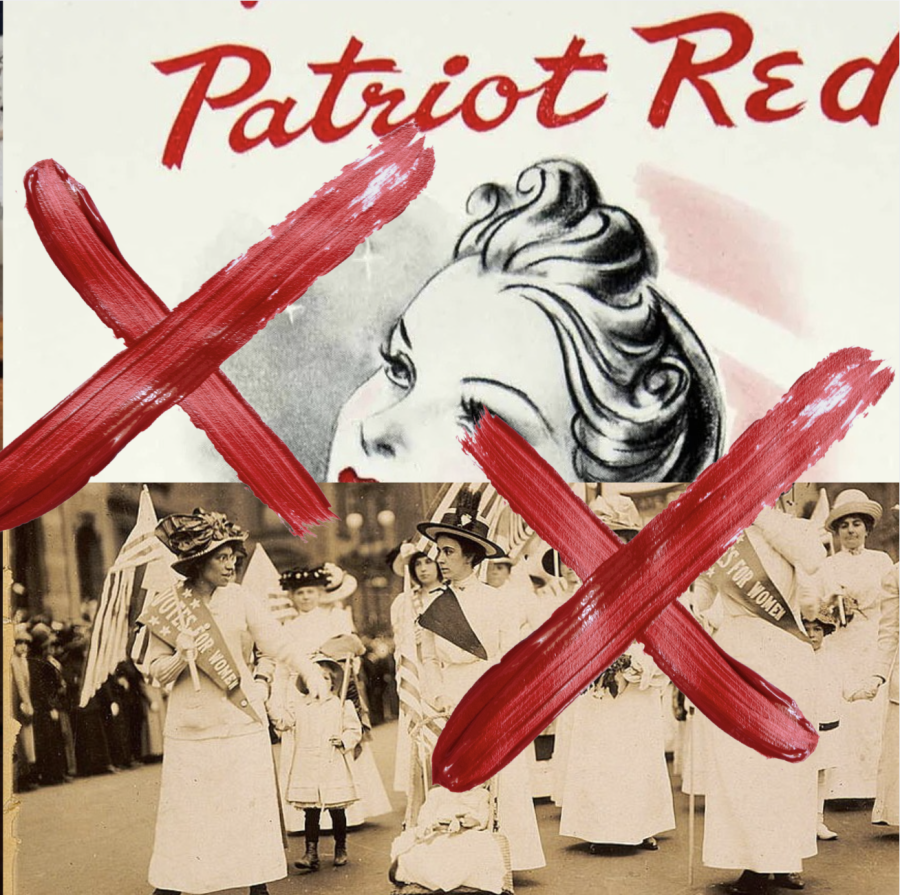
I started wearing red lipstick every day a few years ago, as part of changing my relationship with my body. Nurturing it, paying attention to it. And there is something about putting it on in the morning, looking at yourself in the mirror, and smiling; it does feel powerful.
So when I started researching the history of red lipstick and its connection to women’s rights, I expected to find a good story. What I found was quite a bit more complicated.
The Story Everyone Tells
You’ve probably heard this one. In 1912, a large suffrage march went up Fifth Avenue in New York. As it passed the Elizabeth Arden shop, Arden and her staff ran out with baskets of lipstick and handed them to the marchers like relay batons. From that point onwards, suffragettes wore red lipstick as a symbol of resistance.
It’s a satisfying story. It turns up everywhere: beauty blogs, biography sites, National Geographic, even labels in the Victoria and Albert Museum.
It’s also not true.
Why It Doesn’t Hold Up
The first problem is practical. Lipstick tubes hadn’t been invented yet in 1912. Lip colour came in pots or silk paper wrapping, not something you’d hand out to a crowd of women in white dresses on a warm May evening without making a considerable mess.
The second problem is that Elizabeth Arden didn’t make lipstick in 1912. Her business at that point was skincare: face creams, tonics, and chin straps. Colour cosmetics came later, after she’d travelled to Europe and seen what was happening there. She genuinely did support women, employed them well, paid them fairly. But there is no evidence, none at all, of her being an active member of any suffrage organisation.
So where did the story come from?
Traced to Source
I couldn’t find a proper citation for it but I could find where it became the go-to reference for every beauty blog on the internet. It started as an article/advertorial in Stylist magazine, written by the Elizabeth Arden company to launch a charity lipstick with a UN Women tie-in. That was 2018. From there it spread to Biography.com, then an academic paper, then National Geographic, then everywhere.
The Elizabeth Arden company had access to its own records. They knew what she made in 1912. This was a deliberate decision to attach a founding myth to a product launch.
What makes this particular story sticky is that it gives women something they want: a clean line of descent from political activism to the tube of lipstick on the bathroom shelf. We’re not just wearing lipstick. We’re part of something. That’s worth examining, and I’ll come back to it.
What Actually Happened
The real shift in red lipstick’s acceptance happened between roughly 1921 and 1925. Looking at magazine covers and advertisements from the period, you can trace it: the careful “natural flush” framing of the mid-1910s giving way, by 1925, to bold unambiguous red lips with no apology at all.
This wasn’t political. It was driven by economic independence, advertising, and Hollywood. It was also partly a technical effect. Once panchromatic film stock became standard in the late 1920s, true red could finally register on screen. The dark-lipped silent film stars we associate with red lips weren’t actually wearing red at all. They wore brown tones that photographed dark. Clara Bow, Theda Bara: the red lip association comes largely from retouched publicity photographs and magazine illustrations, not the films themselves.
The Wartime Version
The other main story is the wartime one: that British women were encouraged to wear red lipstick as a patriotic act, that “Beauty is Your Duty” was a government campaign, that Churchill personally protected cosmetics from rationing to keep morale up.
This one is messier. Some of it is real. Some of it is American. And some of it is marketing.
On the American side, “Beauty is Your Duty” and “Victory Red” were largely cosmetics company slogans, not government policy. The American market made sense for this messaging: women at home, worried about loved ones overseas, not in immediate danger themselves. A red lipstick called Victory Red was something you could buy. It gave you something to do.
On the British side, the picture was different. Cosmetics were never formally rationed via coupon books, but that didn’t mean they were available. Production was capped at around 25% of pre-war levels. A purchase tax was added in 1940 and raised to 100% in 1942. By the end of the war, women were melting down lipstick stubs and resetting them with vegetable oil in egg cups. Lipstick was one of the things American GIs brought with them, like silk stockings and chocolate, a scarce gift, not a government-protected morale essential.
Vogue‘s own editorial in August 1942 told readers: “Today, you want to look as if you thought less about your face than about what you have to face, less about your figure than about how much you can do.” That’s not “Beauty is Your Duty.” It’s almost the opposite.
The companies that did use patriotic language, Yardley with “No Surrender” and the British brand Cyclax with a shade called Auxiliary Red for servicewomen, were doing what companies always do. Using the moment to sell product. That’s real, it’s interesting, but it’s not a government campaign.
As for Churchill personally protecting lipstick: this is what historians call Churchillian Drift. Unsourced claims attach themselves to Churchill because he’s vivid and quotable and it’s a good story. The actual record shows cosmetics being taxed, restricted, and scarce. Mary Churchill’s memoir records receiving lipstick in 1944 as a notable present from an American officer, because it was scarce. You don’t give someone a present of something the government has ensured is freely available.
One Story That Is True
I was relieved when I found this one was 100% accurate.
When Bergen-Belsen concentration camp was liberated in April 1945, the British Red Cross arrived with medical supplies. Shortly afterwards, a very large quantity of lipstick arrived. Nobody knew who had ordered it, or why.
Lieutenant Colonel Mervin Willett Gonin, who commanded the medical unit at Belsen in the weeks after liberation, wrote about it in his diary. The original is held at the Imperial War Museum in London.
“This was not at all what we men wanted. We were screaming for hundreds and thousands of other things. And I don’t know who asked for lipstick. I wish so much that I could discover who did it. It was the action of genius, sheer unadulterated brilliance. I believe nothing did more for those internees than the lipstick. Women lay in bed with no sheets and no nightie, but with scarlet red lips. You saw them wandering about with nothing but a blanket over their shoulders, but with scarlet red lips. I saw a woman dead on the post-mortem table and clutched in her hand was a piece of lipstick. At last someone had done something to make them individuals again. They were someone, no longer merely the number tattooed on the arm. At last they could take an interest in their appearance. That lipstick started to give them back their humanity.”
Nobody claimed credit for sending it. It never became a campaign or a brand story. We still don’t know who it was, though I suspect it was a woman, someone who understood without being asked what those women needed, in a way the men around her couldn’t see. The very anonymity of it is part of what makes it real. It wasn’t a marketing exercise.
Why the False Stories Persist
The manufactured myths, 1912 suffragettes, Churchill and his lipstick, Hitler who hated red lips, all have the same structure. A famous figure, a personal gesture, a clear moral. They convert systemic, slow-moving history (economic shifts, advertising, the gradual normalisation of cosmetics over twenty years) into a single vivid moment. Someone did something. Someone stood up to someone else.
When we put on red lipstick and want it to mean something, we reach for that lineage. The defiant suffragette. The wartime woman keeping going. These figures are there in the mirror with us, and the stories that put them there feel true even when they aren’t, because the feeling they describe is real.
The Gonin account doesn’t give us a heroine with a name. It gives us something harder and more genuine: an anonymous act of understanding, documented in a British officer’s diary from April 1945, about what it means to be seen as a person again.
That, I think, is where the red lipstick actually earns its weight.
You may also enjoy …
Finding Time to Make: What Barbara Hepworth Taught Me
Discover how Barbara Hepworth's daily creative practice—amid motherhood and real life—inspires a gentler, lasting way to return to making.
1 year ago
What Andy Goldsworthy’s Ferns Taught Me About Seeing
Ferns at The Royal Scottish Academy, Edinburgh
9 months ago
Marie Antoinette Style at the V&A: A Close Look at the Textiles
I went to the Marie Antoinette Style exhibition at the V&A not expecting much. The textiles changed my mind. A close look at the fabrics, embroidery, and craft skill on show.
2 months ago
Great Glen Charcuterie
Great Glen Charcuterie
11 years ago
 RSS
RSS