Journal
Making a Bag from a UFO: 500 Years of Canvas Work
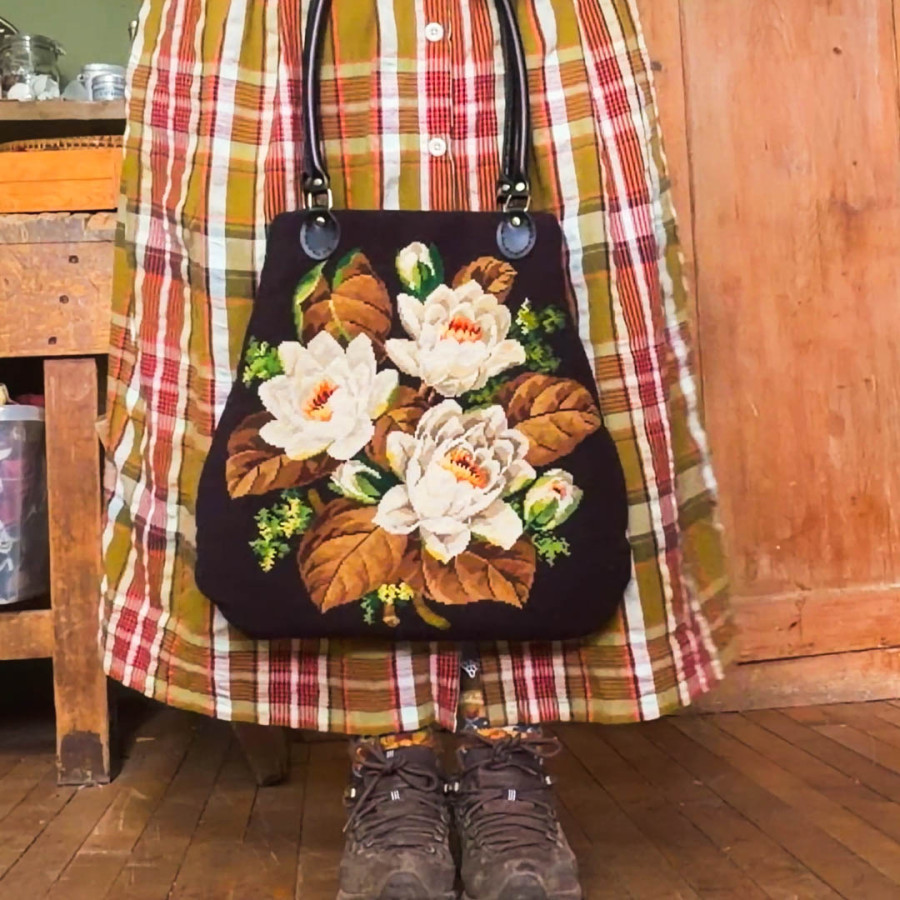
A Victorian needlepoint chair cover that never made it onto a chair. Someone worked and worked on it. All those fine stitches, those white flowers against the dark ground. And then for whatever reason, they just stopped, finished but unused. Maybe they’d planned a set of chairs and never got to the rest. Maybe the cover simply didn’t fit the seat.
I found it on Etsy. And I bought it. And I made it into a bag.
This post is the companion to the film below, which goes into more detail about the history. But the bag is the heart of it, so let’s start there.
The bag itself
This is part of my Maker’s Wardrobe project: a series about making things intentionally, things that will actually be worn, that go with what I already have, and that connect me to a longer history of making.
The needlepoint is Berlin wool work, mid-to-late Victorian. The flowers are either water lilies or magnolias. I genuinely couldn’t decide when I first got it, and I’m still not entirely certain. (One of them might be a water lily. The leaves on the others are very definitely magnolia.) It doesn’t matter enormously. What matters is that someone spent a long time on it, stitch by stitch, working from a chart, and the result is quite beautiful.
To make the bag, I cut three pieces of tweed in the same shape as the needlepoint. Two for the lining, one for the back. I sewed each pair together by hand, put the lining inside, turned both tops together and ironed them. Then I added running stitches in plant-dyed thread across the grid in the backback, which quilted everything together and stopped it feeling floppy. There’s a small pocket in the lining for keys. The handles and catch came from Etsy: leather, with stitch holes.
It’s a fairly simple make, in practical terms. The needlepoint did all the real work, 150 years ago.
A UFO: and why I love them
A UFO is an Unfinished Object. In The Studio, the online creative community I run, we talk about them a lot. Our own unfinished things, yes, but also the things that have been passed down, or found, or stumbled across. Objects that carry someone else’s time and intention and stopped, for reasons we’ll never know.
I have a particular fondness for other people’s unfinished work. There’s something about it that I find easier to approach than my own. The pressure is different. You’re finishing something, not starting it. You’re continuing a line rather than beginning one.
The woman who worked this chair cover: I don’t know her name, or where she lived, or why she stopped. But her hands made this, stitch by stitch. And now it’s a bag I’ll actually use.
Where canvas work comes from
I want to say something about the broader history here, because it changes the way I look at the bag.
Canvas work, embroidery worked in tent stitch onto an evenweave canvas, has been done by women in Britain and Europe for at least 500 years. The technique in this bag is identical to work that has sat in aristocratic houses since the Elizabethan period.
The earliest examples I have are Elizabethan slips: small embroidered motifs, usually flowers or plants, worked in wool and silk on linen canvas in tent stitch, then cut out and appliquéd onto velvet or wool backgrounds. They’re called slips after the horticultural term: a cutting taken to propagate a plant. The designs came from printed herbals and natural history books: William Turner’s A New Herball, John Gerard’s The Herball. Women were working directly from the same botanical publications that physicians and naturalists used.
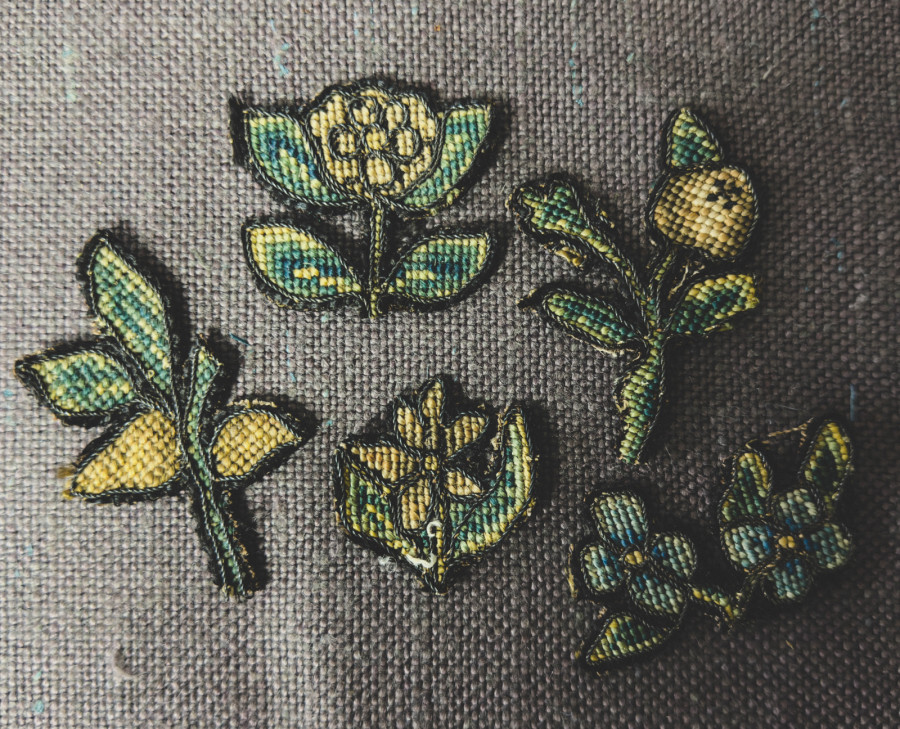
Mary Queen of Scots made work like this during her long imprisonment. An envoy of Elizabeth I reported that she said she spent her days at her needle, and that the diversity of colours made the work seem less tedious, and she continued until the pain made her stop.
The same technique, largely unchanged, runs through the Georgian period, into the early Victorian era, and then into the Berlin wool work craze of the mid-19th century.
Berlin wool work: and why it was ridiculed
Berlin wool work arrived in Britain from Germany in the 1820s, and by the 1840s it had become the dominant form of needlework for middle-class women. The patterns, printed on gridded paper with one square per stitch, were sold as single sheets or in women’s magazines. The wool came from Merino sheep in Saxony, spun in Gotha, dyed in Berlin. The colours were vivid and new, made possible by advances in dyeing and, from the 1850s, by the new aniline dyes.
And almost immediately, people started sneering at it.
The objections were partly aesthetic. William Morris felt it was destroying real needlework skills, reducing embroidery to mechanical square-filling. And they were partly social. Berlin work was popular. It was accessible. It was being done by middle-class women in large numbers, following charts, making choices that had already been made for them by publishers in Germany.
The Royal School of Needlework was founded in 1872 partly as a direct response to Berlin work, to restore the older, freer embroidery traditions that were being crowded out.
Here is what I find interesting about this: the objection to Berlin work was that women were following someone else’s design rather than drawing their own. But Elizabethan embroiderers were also following published patterns — the herbal woodcuts, the printed model buchs. The difference was that the Berlin work system made this visible and industrial. The chart had already made every colour decision for you, and critics could see the mechanism too clearly.
Morris, who objected to this, sold needlework kits through Morris & Co.: linen ready-drawn, threads included. The kit principle was identical. What differed was the class of customer.
The technique in my bag is the same as work that has been in grand houses for 500 years. The only thing that changed was who was doing it.
What the fading tells us
One of the things I find most striking when I look at surviving Berlin work is how muted the colours often are now. The aniline dyes that made Berlin work so exciting were unstable. Within a couple of decades, those vivid crimsons and purples faded to something much more subdued, more “Victorian” in the way we now imagine Victorian, which is to say quieter and duller than it actually was.
This piece, a piece of upholstery where the cushion kept one part in the dark, it shows the original colours against the ones that have faded in light.
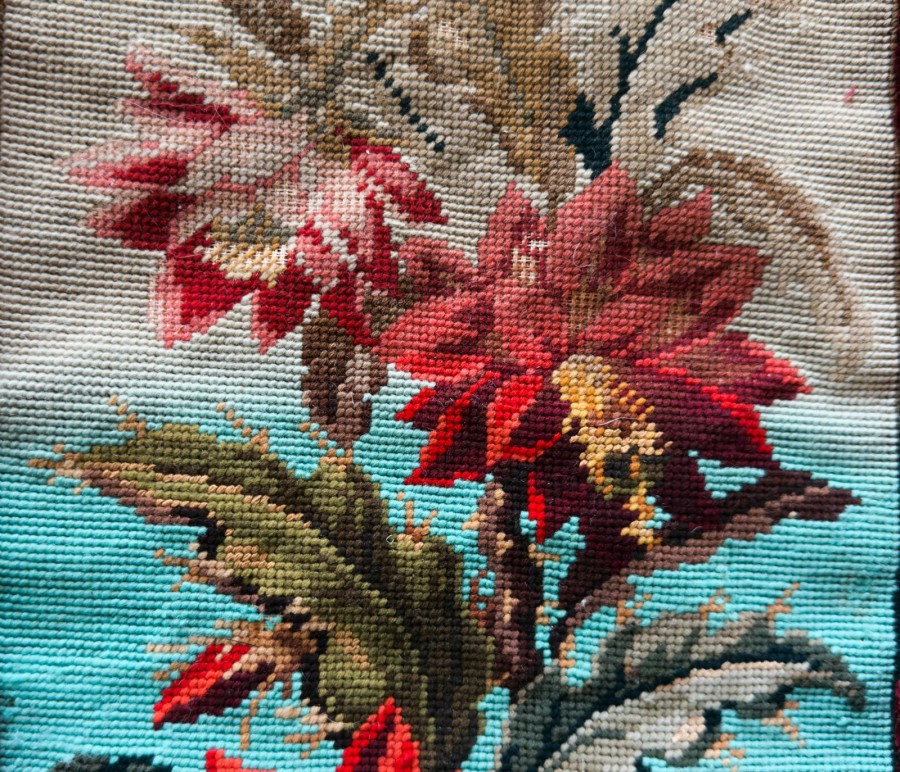
My bag is unfaded, presumably it stayed packed away. The colours are still strong. Which means I’m seeing it much closer to how the maker saw it: bright, vivid, probably considered rather fashionable.
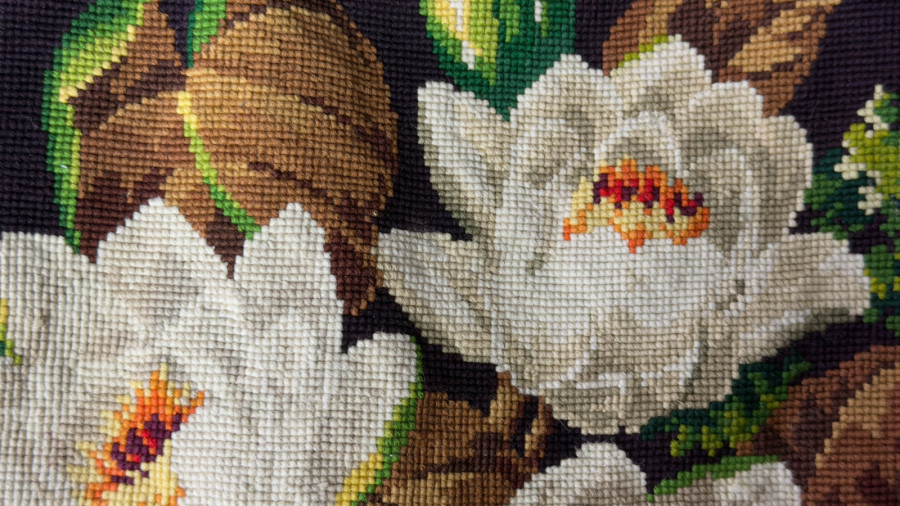
That matters, I think. We judge Berlin work partly by what it looks like now, which is a ghost of what it looked like then.
You may also enjoy …
Botanical Dye Plants: Gorse
Explore the story of gorse — from a symbol of Scottish crofting to a vibrant natural dye. A personal reflection on heritage, migration, and the soft yellow hues of spring.
10 months ago
Using pressed leaves to decorate gift wrap
pressed leaves decorating natural gift wrap.
5 years ago
Mindful sewing project - Patchwork Christmas stocking pattern
Patchwork Christmas stocking pattern
3 years ago
Making an embroidered pincushion.
handmade pincushion from plant dyed velvet and freehand machine embroidery
2 years ago
 RSS
RSS